Calidone
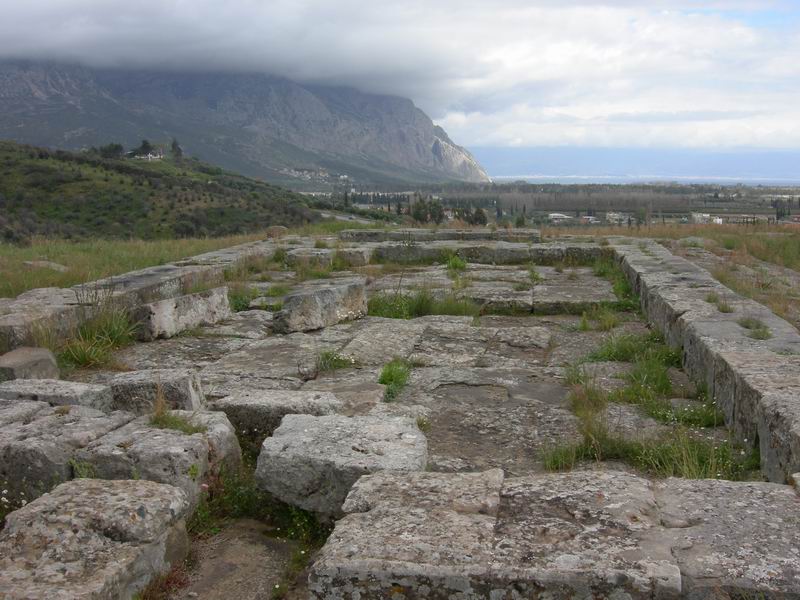
(Kαλυδών) Antichissima città dell'Etolia situata all'ingresso del Golfo di Corinto presso la foce dell'Eveno, ricordata anche da Omero (Il. 2, 640 ecc.). La città sorgeva su due colli e su quello orientale vi era l'acropoli, con mura di cinta dotate di torri. Una via sacra collegava la città al Laphrion, sacro recinto di Artemide e di Apollo; il tempio di Artemide (dorico, esastilo, del 4° sec. a.C.) conteneva il simulacro criselefantino della dea, opera di Menecmo e Soida, del 460 circa; il complesso comprendeva anche un bouleterion, un propileo, una stoa, thesauròi e un Dionysion. Ai due lati della via sacra si ergevano tombe, fra cui un heròon con la sala maggiore decorata alle pareti con immagini clipeate.
La città ebbe per lungo tempo un ruolo importante nella storia greca fino alla sua distruzione avvenuta per mano di Augusto a seguito della fondazione di Nicopoli nel 30 a. C. Il mito vuole che alcuni abitanti di Calidone si stanziarono nell'Elide scacciando, insieme ai Dori, Ossilo, nipote di Toante e sesto discendente di quell'Etolo che era stato scacciato dall'Elide ed era riparato nella terra che prese il suo nome.
Uno dei re più celebri fu Eneo. La leggenda narra che Dioniso, ospite del re, si innamorò di sua moglie Altea. Eneo, comprendendo il desiderio del dio, si allontanò per favorire l'unione (dalla quale nacque Deianira) e Dioniso, per sdebitarsi, gli fece dono della prima pianta di vite (Apollodoro 1, 8, 1 e ss.), introducendo la viticoltura nella regione. Tuttavia, la fortuna di Eneo mutò quando dimenticò di offrire le primizie del raccolto ad Artemide: l'offesa scatenò l'ira della dea, che per vendetta inviò il terribile Cinghiale Calidonio a devastare le terre del re.
Artemide era la divinità tutelare di Calidone (noti i resti del Laphrion venuti alla luce negli scavi di Calidone), venerata con l'appellativo di Lafria. Sebbene l'iconografia classica la ritraesse come cacciatrice, i complessi rituali celebrati in suo onore (poi trasferiti a Patrasso) suggeriscono un'origine molto più antica. L'olocausto di animali selvatici e frutti della terra la connota come una "Signora delle Fiere", dispensatrice di vita e morte (Omero Il. 9, 533 sgg.; Apollodoro 1, 8, 2). Il nome Lafria potrebbe derivare da labrys (la scure bipenne) o da elaphros (agile), richiamando la velocità della sua punizione o la forza vitale che infondeva. Il suo culto creò legami profondi tra Calidone, Messene e Cefalonia, dove la dea veniva talvolta identificata con Britomarti, la ninfa cretese che scelse la verginità eterna.
Artemide causò grandi disgrazie a Eneo, alla quale il re, dimenticò di dedicare parte del sacrificio, quando a tutti gli dei offrì le primizie dei frutti dell'annata.
La dea era onorata, oltre che a Calidone, a Patrasso e a Messene, anche a Cefallenia (sotto i versi di Antonino Liberale, Metamorfosi 40, che la identifica con Britomarti)
...Cassiopea e Fenice ebbero per figlia Carme. Zeus si unì a lei e generò Britomarti. Questa, fuggendo il commercio con gli uomini, si compiacque di restar vergine per tutta la vita. Dalla Fenicia si recò dapprima ad Argo presso Bize, Melite, Maira e Anchiroe, le figlie di Erasino. Da Argo si portò poi a Cefalonia, dove gli abitanti la soprannominarono Lafria e le offrirono sacrifici come a una dea… .
Fu in prossimità di questa città che Eracle lottò contro il dio-fiume Acheloo, capace di presentarsi in tre aspetti: in forma di toro, di drago e di uomo con testa di bue e barba ruscellante (Sofocle Trachinie 9-14). Ingaggiata la lotta con Acheloo, che si presentava con l'aspetto di toro (Igino, 31,7), Eracle riuscì a domarlo e a spezzargli un corno. Un'interpretazione razionalistica di questa lotta è data da Diodoro (4, 35, 3-4), il quale spiega che Eracle, per fare un favore ai Calidoni, deviò il fiume Acheloo in un alveo da lui scavato e rese così molto fertile una grande parte della campagna calidonia.
Molti i miti correlati, fra i più famosi i seguenti:
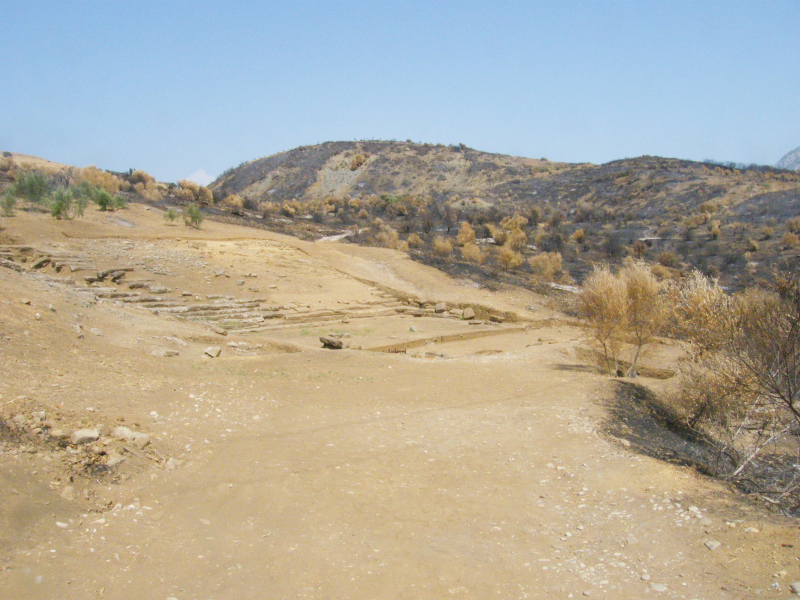
Disgraziatamente uno degli ultimi incendi ha devastato il sito rendendolo poco agibile, e per questo motivo disponiamo di poche immagini.
Calidon
(Kαλυδών) A very ancient city in Aetolia, located at the entrance to the Gulf of Corinth near the mouth of the Evenus, also mentioned by Homer (Il. 2, 640 etc.). The city stood on two hills, with the acropolis on the eastern one, surrounded by walls with towers. A sacred road connected the city to the Laphrion, the sacred precinct of Artemis and Apollo; the temple of Artemis (Doric, hexastyle, 4th century BC) contained the chryselephantine statue of the goddess, the work of Menaechmus and Soidas, from around 460; The complex also included a bouleterion, a propylaea, a stoa, thesauroi, and a Dionysion. Tombs stood on both sides of the sacred way, including a heron with the largest hall decorated on the walls with clipeate images.
The city played an important role in Greek history for a long time until its destruction at the hands of Augustus following the founding of Nicopolis in 30 BC. Legend has it that some inhabitants of Calydon settled in Elis, expelling, together with the Dorians, Oxylus, grandson of Thoas and sixth descendant of the Aetolian who had been expelled from Elis and had taken refuge in the land that took his name.
One of the most famous kings was Oeneus. Legend has it that Dionysus, a guest of the king, fell in love with his wife Althaea. Aeneas, understanding the god's desire, left to facilitate the union (which resulted in the birth of Deianira), and Dionysus, in return, gave him the gift of the first vine (Apollodorus 1, 8, 1 ff.), introducing viticulture to the region. However, Aeneas's fortunes changed when he forgot to offer the first fruits of his harvest to Artemis: the offense unleashed the wrath of the goddess, who in revenge sent the terrible Calydonian Boar to ravage the king's lands.
Artemis was the tutelary deity of Calydon (the remains of the Laphrion discovered during the excavations at Calydon are well known), venerated under the name of Laphria. Although classical iconography portrayed her as a huntress, the complex rituals celebrated in her honor (later transferred to Patras) suggest a much more ancient origin. The sacrifice of wild animals and fruits of the earth connotes her as a "Lady of the Beasts", dispenser of life and death (Homer Il. 9, 533 ff.; Apollodorus 1, 8, 2). The name Laphria could derive from labrys (the double-headed axe) or from elaphros (agile), recalling the speed of her punishment or the life force she instilled. Her cult created deep ties between Calydon, Messene, and Cephalonia, where the goddess was sometimes identified with Britomartis, the Cretan nymph who chose eternal virginity.
Artemis brought great misfortune upon Oeneus, to whom the king forgot to dedicate part of the sacrifice when he offered the first fruits of the year to all the gods.
The goddess was honored not only in Calydon, Patras, and Messene, but also in Cephallenia (in the verses of Antoninus Liberalis, Metamorphoses 40, who identifies her with Britomartis).
...Cassiopeia and Phoenix had a daughter, Carme. Zeus intercoursed with her and fathered Britomartis. She, fleeing commerce with men, was pleased to remain a virgin all her life. From Phoenicia, she went first to Argos, to Bizae, Melite, Maira, and Anchiroe, the daughters of Erasinous. From Argos, she then went to Cephallonia, where the inhabitants nicknamed her Laphria and offered sacrifices to her as to a goddess...
It was near this city that Heracles fought the river-god Achelous, who could appear in three forms: a bull, a dragon, and a man with the head of an ox and a flowing beard (Sophocles Trachinian 9-14). Having engaged in combat with Achelous, who appeared in the form of a bull (Hyginus, 31.7), Heracles managed to tame him and break off one of his horns. A rationalistic interpretation of this fight is given by Diodorus (4, 35, 3-4), who explains that Heracles, as a favor to the Calydonians, diverted the river Achelous into a riverbed he had dug, thus making a large part of the Calydonian countryside very fertile.
There are many related myths, among the most famous are the following:
Unfortunately, one of the latest fires devastated the site, making it difficult to access, and for this reason we have few images.