Efeso
Situata in Asia Minore, alla foce del fiume Caistro era una antichissima città della Lidia, facente parte alla confederazione delle dodici colonie ioniche.
Secondo la tradizione, fu fondata dalle Amazzoni, passata successivamente sotto il dominio dei Cari, dei Lelegi e, per finire, sotto il dominio di Atene. Come tutte le altre colonie ioniche fu sotto il dominio di Creso dei Macedoni dei Persiani dei Tolomei dei Seleucidi e di Roma che, nel 121 a.C. ne fece la capitale della sua provincia d'Asia.
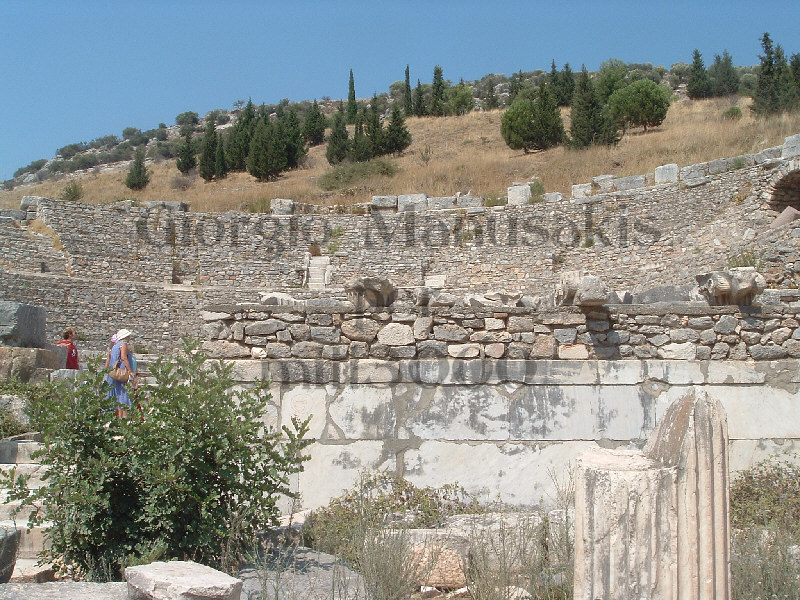
Gli scavi archeologici hanno portato alla luce importanti resti di monumenti antichi e cristiani. Fin dall'antichità fu celebre per l'Artemision, santuario in onore di Artemide (Diana Efesina). Il tempio, considerato una delle sette meraviglie del mondo, era stato progettato da Chesifrone di Cnosso, e la costruzione durò parecchi anni. Incendiato da Erostrato la notte stessa in cui nacque Alessandro Magno (21 luglio 356 a. C.), fu riedificato da Dinocrate. Era grande quattro volte il Partenone, ricco di sculture di Prassitele e di pitture di Parrasio e di Apelle. La statua della dea era di legno d'ebano (secondo Plinio) o di cedro (secondo Vitruvio). Fu distrutto una seconda volta dai Goti (metà del III sec. d.C.) e infine del tutto demolito per ordine di Costantino. Sono stati rinvenuti inoltre molti altri edifici di notevole interesse archeologico, tra cui i templi di Serapide (sec. II) e di Adriano, lo stadio (sec. I), il teatro (sec. I-II), la biblioteca di Celso (110-35).
Fra i suoi cittadini più illustri:
- Callino (VIII-VII sec. a.C.) uno dei massimi poeti elegiaci greci. Una delle sue elegie giunta a noi, incompleta,consiste di 21 versi nei quali esorta la gioventù a combattere contro gli invasori; di Eròstrato, nel 356 a.C., la stessa notte in cui nacque Alessandro Magno, per rendersi celebre, incendiò il tempio di Artemide in Efeso. Fu per questo condannato a morte dai suoi concittadini.
- Artemidoro, scrittore del I sec. a.C., autore del trattato: "L'interpretazione dei sogni";
- Agasia, nome di due scultori attivi alla fine del II sec. a.C. Uno è l'autore del "Gladiatore" (Parigi, Louvre). L'altro è autore del "Guerriero ferito" di Delo (Atene, Museo nazionale).
- Zenodoto di Efeso, filologo del III sec. a.C., educò i figli di Tolomeo Sotere e diresse la biblioteca di di Tolomeo Filadelfo, ad Alessandria. Pubblicò un'edizione critica dell' "Iliade" e dell'"Odissea";
- Demetrio,(seconda metà del V sec. a.C.), lavorò e portò a compimento, in collaborazione con Peonio, il tempio di Artemide a Efeso, che, dopo la distruzione del 346 a.C., venne ricostruito dall'architetto Dinocrate, sotto Alessandro Magno.
- Ermodòro, filosofo vissuto nel sec. V a.C. Viene citato da Eraclito, secondo il quale Ermodoro sarebbe stato esiliato dai suoi concittadini dopo il suo tentativo di governare Efeso. Secondo la tradizione, poi, si sarebbe rifugiato a Roma dove avrebbe collaborato alla stesura delle Dodici Tavole.
- Eràclito filosofo del VI sec. (Efeso 540 a.C. ca-480 ca). Secondo la tradizione condusse vita solitaria, immerso totalmente negli studi. Fu soprannominato l'«oscuro», per la difficoltà d'interpretazione dei suoi concetti, e anche «il triste» o «il piangente» per il suo pessimismo.
- Sorano, medico greco vissuto intorno al II secolo d.C. ad Alessandria e a Roma; è considerato il fondatore della moderna ginecologia e dell'ostetricia scientifica.
- Rufo, medico del I secolo d. C., fu grande studioso di anatomia e scrisse numerosi trattati, di cui ora non restano che pochi frammenti riportati da Galeno, nei quali fissava anche un'ampia nomenclatura rimasta fino ai nostri giorni.
- Apelle, pittore del IV sec. a.C., il piú celebre dell'antichità. Preferito da Alessandro Magno. Visse a Colofone, Efeso, Coo. Fu autore di molte opere, tra cui una "Afrodite Anadiomene" che Augusto fece pervenire a Roma da Coo. Introdusse il valore tonale nella pittura ottenendo immagini ricche di volume e movimento;
- Apollonio di Tiana, filosofo neopitagorico (I-II sec. d.C.) fu oggetto di un culto personale: l'imperatore Caracalla gli dedicò un tempietto, inoltre la sua immagine ornava numerosi templi e ad Efeso era venerato come un dio.
- Ipponatte poeta del VI sec. a.C., autore di giambi dei quali restano pochi frammenti. Probabilmente a causa del crudo carattere dei suoi versi, la tradizione lo rappresenta come un popolano deforme. Della sua poesia restano pochi mutili frammenti, alcuni di acceso realismo, altri di vivace ironia, tutti comunque tali da farci rimpiangere di avere perduto nei secoli la sua opera;
- Chersìfrone, architetto cretese dal VI sec. a.C. ideatore e costruttore, assieme al figlio Metagene, del famoso tempio di Diana di Efeso (definito una delle sette meraviglie del mondo). Nel 356 a.C. il grandioso monumento fu incendiato da Erostrato.
Fra le opere letterarie più famose:
Le lettere Efesie, formule magiche che venivano incise su amuleti e che servivano a tenere lontane le malattie. Venivano così chiamate perché sarebbero state incise per la prima volta sul piedistallo della statua di Artemide a Efeso.
Le feste più importanti:
le Efesie o efesiache o Artemisie, venivano celebrate in primavera in onore di Artemide. Venivano compiuti sacrifici e si indicevano giochi, danze e concorsi letterari.
Ἔφεσος, located in Asia Minor, at the mouth of the River Kaistro, was an ancient city of Lydia, part of the confederation of the twelve Ionian colonies.
According to tradition, it was founded by the Amazons, subsequently passed under the rule of the Carians, the Leleges, and, finally, under the rule of Athens. Like all the other Ionian colonies, it was under the rule of Croesus, the Macedonians, the Persians, the Ptolemies, the Seleucids, and Rome, which, in 121 BC, made it the capital of its province of Asia.
Archaeological excavations have uncovered important remains of ancient and Christian monuments. Since ancient times, it has been famous for the Artemision, a sanctuary in honor of Artemis (Diana of Ephesus). The temple, considered one of the seven wonders of the world, was designed by Chesiphron of Knossos, and construction took several years. Set on fire by Herostratus on the very night of Alexander the Great's birth (July 21, 356 BC), it was rebuilt by Dinocrates. It was four times the size of the Parthenon, rich in sculptures by Praxiteles and paintings by Parrhasius and Apelles. The statue of the goddess was made of ebony (according to Pliny) or cedar (according to Vitruvius). It was destroyed a second time by the Goths (mid-3rd century AD) and finally completely demolished by order of Constantine. Many other buildings of notable archaeological interest have also been discovered, including the temples of Serapis (2nd century) and Hadrian, the stadium (1st century), the theater (1st-2nd centuries), and the library of Celsus (110-35).
Among its most illustrious citizens:
- Callinus (8th-7th century BC), one of the greatest Greek elegiac poets. One of his elegies, incomplete, has survived, consisting of 21 verses in which he exhorts the youth to fight against the invaders; Herostratus, in 356 BC, on the same night Alexander the Great was born, to make himself famous, he burned the temple of Artemis in Ephesus. For this he was condemned to death by his fellow citizens;
- Artemidorus, a 1st-century BC writer, author of the treatise "The Interpretation of Dreams";
- Agasias, the name of two sculptors active at the end of the 2nd century BC. One is the author of "Gladiator" (Paris, Louvre). The other is the author of "Wounded Warrior" of Delos (Athens, National Museum);
- Zenodotus of Ephesus, a philologist of the third century BC, educated the sons of Ptolemy Soter and directed the library of Ptolemy Philadelphus in Alexandria. He published a critical edition of the "Iliad" and the "Odyssey";
- Demetrius (second half of the fifth century BC), in collaboration with Paeonius, worked on and completed the Temple of Artemis in Ephesus, which, after its destruction in 346 BC, was rebuilt by the architect Dinocrates under Alexander the Great;
- Hermodorus, a philosopher who lived in the 5th century BC. He is mentioned by Heraclitus, who claims that Hermodorus was exiled by his fellow citizens after his attempt to govern Ephesus. According to tradition, he then took refuge in Rome, where he collaborated on the drafting of the Twelve Tables;
- Heraclitus, a philosopher of the 6th century (Ephesus c. 540 BC-c. 480 BC). According to tradition, he led a solitary life, totally immersed in his studies. He was nicknamed "the obscure" due to the difficulty in interpreting his concepts, and also "the sad" or "the weeping" for his pessimism;
- Soranus, a Greek physician who lived around the 2nd century AD in Alexandria and Rome; he is considered the founder of modern gynecology and scientific obstetrics;
- Rufus, a physician of the 1st century AD. C. was a great scholar of anatomy and wrote numerous treatises, of which now only a few fragments remain, reported by Galen, in which he also established a broad nomenclature that has remained to the present day.
- Apelles, a 4th-century BC painter, the most famous of antiquity. A favorite of Alexander the Great, he lived in Colophon, Ephesus, and Cos. He was the author of many works, including "Aphrodite Anadyomene," which Augustus had brought to Rome from Cos. He introduced tonal value into painting, achieving images rich in volume and movement;
- Apollonius of Tyana, a Neo-Pythagorean philosopher (1st-2nd century AD), was the object of a personal cult: the emperor Caracalla dedicated a small temple to him, and his image adorned numerous temples, and he was venerated as a god in Ephesus;
- Hipponax, a poet of the 6th century BC, author of iambics, of which only a few fragments remain. Probably because of the crude nature of his verse, tradition portrays him as a deformed commoner. Only a few mutilated fragments of his poetry remain, some of fiery realism, others of lively irony, all of which, however, make us regret having lost his work over the centuries;
- Chersiphron, a Cretan architect from the 6th century BC, designer and builder, together with his son Metagenes, of the famous Temple of Diana at Ephesus (deemed one of the seven wonders of the world). In 356 BC, the grandiose monument was set on fire by Herostratus.
Among the most famous literary works:
The Ephesian Letters, magical formulas that were engraved on amulets and served to ward off illnesses. They were so called because they were first engraved on the pedestal of the statue of Artemis in Ephesus.
The most important festivals:
The Ephesian or Ephesian Festivals or Artemisia, were celebrated in spring in honor of Artemis. Sacrifices were performed and games, dances, and literary competitions were held.