Fonte Aretusa
Situata nella parte sud-occidentale dell'isola di Ortigia, essa è conosciuta fin dall'antichità. Durante i secoli la sua fama è molto cresciuta, insieme al mito che l'ha sempre accompagnata. La sua storia è intimamente legata a quella di Siracusa, fin dalla nascita avvenuta nel 734 a. C., fin da quando cioè Archia di Corinto della famiglia degli Eraclidi, secondo Tucidide, ricevette una profezia dall'Oracolo che gli indicava il luogo presso il quale fondare una nuova città, una volta abbandonata la sua "polis": una fonte dove le acque di una ninfa sgorgavano accanto al mare su una piccola isola della grande Trinacria.
Erano tempi in cui per la ristrettezza e la povertà del territorio molte genti si mossero dalla Grecia in cerca di nuovi spazi, abbandonando un territorio che, seppure splendido da un punto di vista paesaggistico, poco offriva dal punto di vista alimentare.
La scarsa presenza di pianure e l'abbondanza di terreni montuosi e sassosi, permettevano solo una pastorizia di semplice sussistenza, riservando alle coste una potenzialità maggiore per via del pescato. I Greci, spinti dalla curiosità e, soprattutto, dalla necessità, espatriarono in grande quantità lungo il Mediterraneo, fondando numerose città, diffondendo la loro cultura e seminando conoscenza in vastissime superfici di gran lunga superiori, come estensione, alla modestissima Grecia.
È interessante notare come, dopo i primi momenti di cruenti contrasti, essi riuscirono ad amalgamarsi con le popolazioni locali, trasformandone in meglio gli usi e le tradizioni, lo stile di vita insomma, non tralasciando mai i rapporti con la madrepatria che rimasero frequenti ed importanti.
Erano navigatori abilissimi, forgiatisi alla grande scuola navale ellenica, profondi conoscitori dei venti che fanno del Mediterraneo un mare a volte difficile da navigare, anche d'estate quando la stagione sembra più propizia. Improvvise tempeste sorprendevano gli equipaggi e anche se la navigazione avveniva soprattutto di giorno e sottocosta, cioè a vista, le navi in balia delle onde andavano spesso a naufragare contro gli scogli delle coste bordate. Lo testimonia la ricchezza dei fondali, paradiso per subacquei e appassionati archeologi.
Tesori inestimabili specialmente per il loro valore storico e documentaristico, giacciono ancora su tanti fondali marini, nonostante una grande quantità di reperti si trovi già nei musei al sicuro insieme, purtroppo ad un'altra quantità, forse maggiore, andata perduta perché frutto di predatori dagli scarsi scrupoli che ne hanno fatto vile commercio.
La profezia, dicevamo, parlava di una piccola isola della più grande Trinacria e di una fonte prodigiosa di acqua dolce a pochi passi dal mare, manifestazione visibile della pietà di una dea che aveva fatto rinascere una ninfa sottoforma di sorgente.
Il mito di Aretusa è uno dei più antichi e belli che la cultura greca ci abbia tramandato e, nonostante siano passati decine di secoli, affascina ancora per quel misto di amore e di dolore che contraddistingue la vicenda dei due protagonisti.
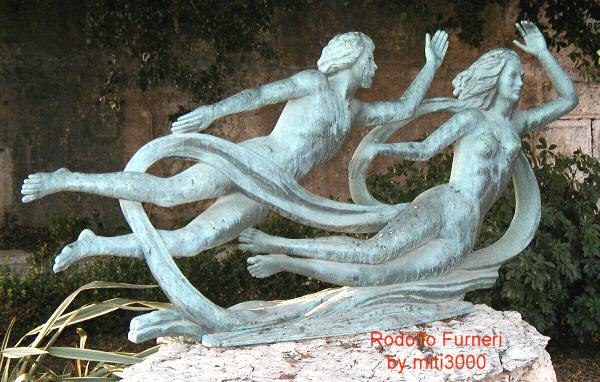
La vicenda ha tutti presupposti di una grande storia d'amore. Ci sono i due protagonisti: Aretusa, ancella di Artemide, la dea della caccia, e Alfeo, dio di un fiume, figlio di Oceano perdutamente innamorato della giovane ninfa. Secondo il mito, Aretusa un giorno s'immerse per il caldo nelle acque del fiume e Alfeo che viveva sulle sue sponde, appena la vide, se ne innamorò. Aretusa spaventata fuggì, invocando Artemide che per salvarla la trasformò in una fonte, facendola sgorgare sull'isola di Ortigia. Alfeo sconvolto dal dolore si trasformò in un fiume e, attraversando il fondo del mare Ionio, riemerse proprio accanto ad Aretusa, mescolando le sue acque con quelle dell'amata ninfa. Vicino ad essa, infatti, esiste un'altra sorgente chiamata l'Occhio della Zillica che la fantasia popolare ha sempre ritenuto essere la presenza di Alfeo.
Secondo un'altra versione Aretusa durante la fuga sarebbe caduta dalle coste dell'Elide e dopo la sua morte sarebbe trasformata in fonte. A me che sono rimasto inguaribilmente romantico, piace ricordare la versione, credo di Shelley, secondo la quale Aretusa ed Alfeo erano due giovani innamorati. Un brutto giorno Aretusa, cadde da una rupe sul mare e morì, ma da Artemide venne trasformata in fonte, sorgente proprio ad Ortigia. Il dolore di Alfeo commosse Zeus che lo trasformò in fiume, permettendogli così, scorrendo sotto il mare Ionio, di raggiungere Aretusa e di mescolare le sue acque con quelle dell'amata ninfa.
Il mito di Aretusa simboleggia, in effetti, il grande legame che univa questa colonia greca alla madrepatria e la voglia dei Siracusani di sottolineare questa appartenenza al di là del tempo e dello spazio. Teocrito nelle "Siracusane" sottolinea questa appartenenza, facendo dire a delle donne di essere fiere di discendere da coloni venuti da Corinto e, per questo, usi a parlare la greca lingua.
Un'ulteriore conferma di questo profondo legame è testimoniato dal fatto che si riteneva vero che quando ad Olimpia avvenivano dei sacrifici le acque della fonte si tingevano di rosso. Siracusa, tra le altre, fu proprio la colonia greca che riuscì a svilupparsi meglio, raggiungendo uno splendore e una potenza paragonabile o, in diversi casi, superiore a quelli di molte città greche. L'arte, la filosofia le scienze e la cultura in generale in questa città vennero favorite da tiranni illuminati, perfino da Dionisio il Vecchio, che partecipava a concorsi letterari in Grecia con tragedie scritte proprio da lui.
Il luogo e il mito hanno ispirato nel corso dei secoli decine di poeti e scrittori come: Ovidio e Silio, Virgilio e Pindaro, Pindemonte, Gregorovius, D'Annunzio, Quasimodo, Carducci, Milton, Shilley, Andrè Gide e Cicerone, per citarne alcuni. Essi si sono ispirati a questo luogo e a questo mito, come se specchiandosi nelle acque della fonte, fossero rimasti ammaliati per incanto da una sottile magia. In una sua poesia Giosuè Carducci così si esprime:
"amore, amor, sussurran l'acque
e Alfeo chiama nei verdi talami Aretusa"
e Salvatore Quasimodo:
"Non un luogo dell'infanzia
cerco, e seguendo sottomare il fiume,
già prima della foce in Aretusa,
annodare la corda
spezzata dell'arrivo."
Per gli antichi l'acqua era un bene prezioso e, soprattutto, per i coloni che per primi avevano attraversato il mare per giorni e settimane e che provenivano da terre notoriamente povere di sorgenti e di fiumi, la scoperta di fonti d'acqua dolce così a ridosso del mare dovette sembrare la manifestazione evidente della benevolenza di qualche divinità.
Per l'ammiraglio inglese Nelson, addirittura, era un luogo portafortuna, perché egli, dopo avere approvvigionato di acqua le sue navi, battè la flotta francese di Napoleone, ad Abukir nelle acque del Mediterraneo, al largo dell'Egitto.
La fonte, descritta anche da geografi arabi come Edrisi vissuto nel XII secolo, insieme ad altre vicine, è stata utilizzata per secoli per la concia delle pelli. A causa di terremoti ed incuria il luogo si era ridotto ad uno squallido lavatoio. Nel tempo, essa ha subito molti rifacimenti. L'aspetto attuale di grande fascino ambientale è dovuto all'ultima sistemazione del 1843, sotto l'Amministrazione del sindaco Borgia.
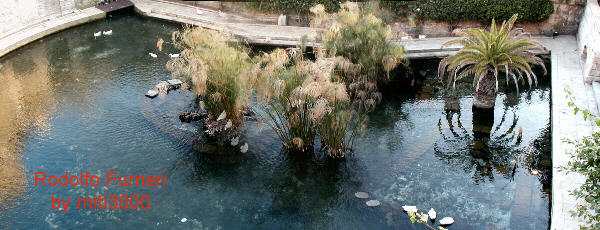
Lo specchio d'acqua, in una vasca semicircolare, si apre visualmente verso il mare, delimitato da esili ed eleganti ringhierine di ferro; il fondo gorgoglia per il continuo afflusso di acqua dolce. Il verde trionfa grazie ai papiri e alle piante acquatiche, in mezzo alle quali pesci d'acqua dolce nuotano in grande quantità, mentre i piccioni svolazzano goffamente sopra o ai margini di essa. Sgorga a poco più di mezzo metro sul livello dl mare ed è naturalmente soggetta, come tutte le fonti, a variabilità stagionale.
Localmente viene chiamata "'a funtana 're pàpiri" (la fontana delle anatre) per via di quegli uccelli e dei cigni che sfilano come in una passerella, scivolando e galleggiando sulle sue acque.
In effetti, si tratta di una delle numerosissime sorgenti naturali che caratterizzano tutta la costa a sud di Siracusa, frutto della generosissima falda freatica iblea che, durante la stagione delle piogge, accumula grandi quantità d'acqua. Rilasciandola gradatamente nel corso dell'anno, essa da luogo in prossimità del mare a molte polle sorgive, alcune delle quali famose come quella che da origine al breve corso del fiume Ciane, che sfocia nel Porto Grande di fronte all'isola di Ortigia. Un'altra località a quindici chilometri a sud di Siracusa è, addirittura, chiamata Fontane Bianche per la presenza di fonti d'acqua dolce, che scaturiscono da rocce chiarissime, lambite dal mare.
Il territorio degli Iblei, il massiccio montuoso a sud della Sicilia con cime di modesta altitudine (M.te Lauro 984 m.s.l.), interessa ben tre province: Siracusa, Ragusa e Catania. Di natura calcarea, ricco di un'incredibile quantità di fossili, è stato soggetto al fenomeno carsico. Nel tempo questo processo ha trasformato il carbonato di calcio insolubile in bicarbonato, il quale si è sciolto nell'acqua filtrante, lasciando grandi e vuote concamerazioni interne, rendendo il tutto simile ad un enorme gruviera. Questo ha permesso e permette ancora oggi un lento deflusso verso il mare di tutte le acque che in profondità lo attraversano.
Territorio di enorme importanza storica e culturale, sede naturale di numerose popolazioni e di importanti siti archeologici, dichiarato Patrimonio dell'Umanità da parte dell'Unesco, trae la sua origine da fondali marini mediterranei di milioni di anni fa, sollevatisi grazie all'orogenesi alpina.
La fonte, come abbiamo già detto, sorge sull'isola di Ortigia, lunga circa un chilometro, di grande importanza strategica, provvista di due porti naturali il primo, quello grande, ad uso mercantile e militare e il secondo, più piccolo, per le attività di pesca e della cantieristica. Qui sono ancora visibili i resti dell'Arsenale dove venivano prodotte le navi siracusane, alcune delle quali sono passate alla storia della navigazione, come quella fatta costruire da Archimede e che tutt'oggi risulta essere la più grande dell'antichità, una sorta d'ammiraglia, una specie di catamarano con due navi gemelle, unite da ponti trasversali, che poteva contenere una quantità incredibile di soldati e di merci.
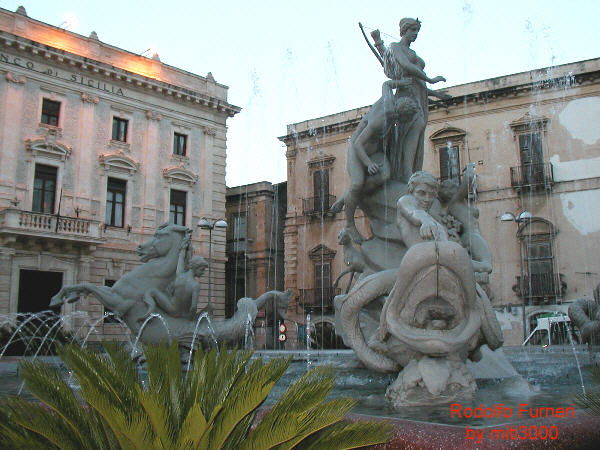
Archia il fondatore di Siracusa, trovò l'isola già abitata dai Siculi ed arduo dovette essere il suo compito perché essi, pur non essendo genti molto bellicose, mal si adattarono a questa nuova situazione che li scacciava da un luogo così delizioso, bramato anche in seguito da tante popolazioni. Ogni angolo, infatti, nasconde segni importantissimi del passato. Il sottosuolo, poi, è un'autentica miniera. Sotto edifici già di per sé famosi ci sono vestigia dell'antica Siracusa, come ad esempio il tempio ionico sito sotto lo splendido Palazzo Vermexio, sede del comune. Ortigia è un'isola che conserva, dopo averle mescolate, tutte le impronte delle culture delle genti che l'hanno conquistata: i Greci, i Romani, i Bizantini, gli Arabi, i Normanni, gli Angioini, gli Aragonesi e gli Svevi.
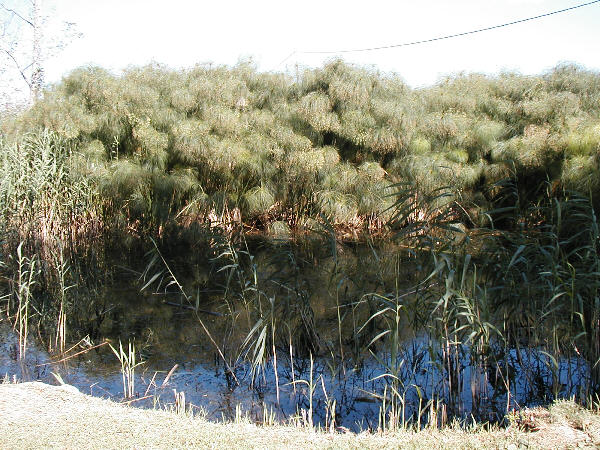
Pochi posti al mondo possono vantare una simile concentrazione di resti di civiltà che, soprattutto nel Mediterraneo, hanno espresso la loro vitalità, contribuendo allo sviluppo del mondo moderno.
Una luce che filtra tra le viuzze e le piccole piazze, quasi nascoste tra gli edifici che incombono serrati su di esse, rende nelle giornate di sole con lo spessore delle forme, contrasti di luminosità di grandissimo effetto. I palazzi che si affacciano sulla Marina del Porto Grande sfavillano con i loro rossori morbidi nel pomeriggio che diventa sempre più sera. Luci ed ombre qui sembrano protagonisti di una titanica lotta che non avrà mai vincitori, ma che permette al tramonto e, soprattutto in prossimità della fonte, panorami di una suggestione profonda, di una malìa che affascina e che non potrà più essere dimenticata da chi ha avuto o avrà la fortuna di ammirarli.
Tino Insolia
L’anfiteatro
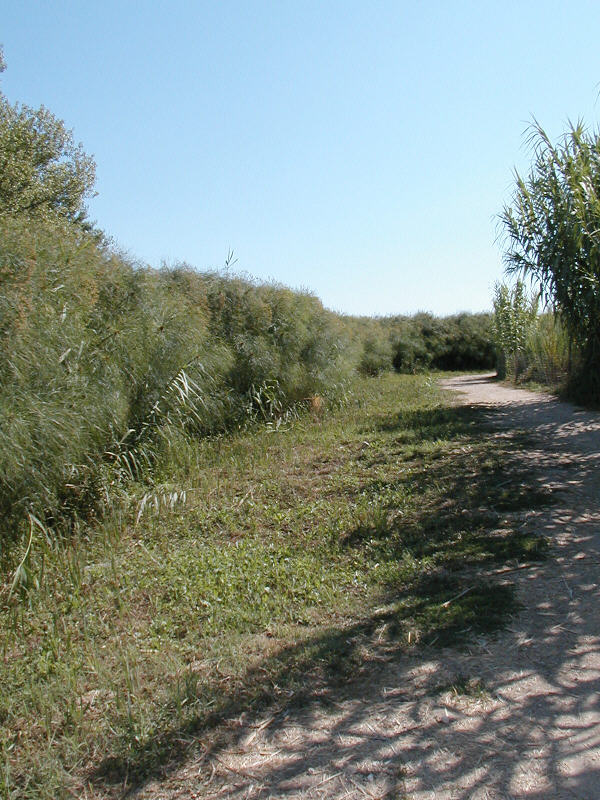
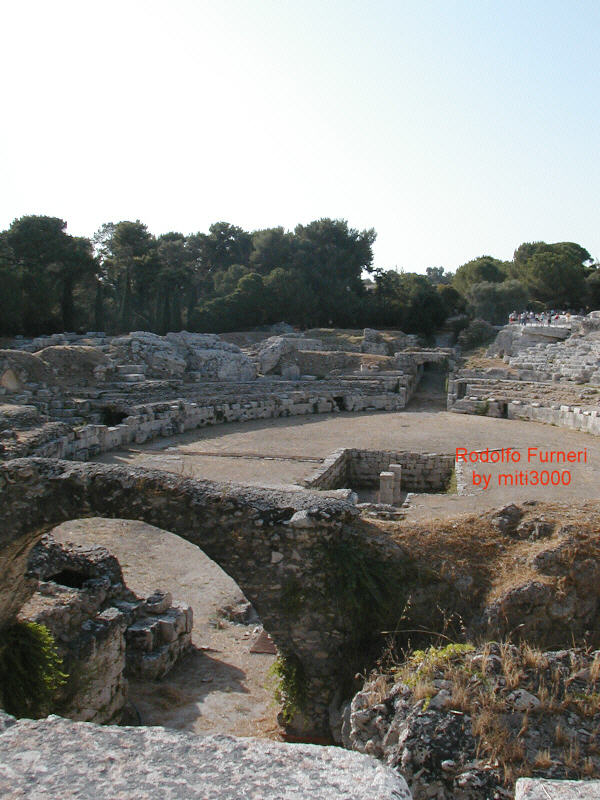
dal greco ἀμφί - Amphi’ e θέᾱτρον - The’atron= teatro da ambedue le parti) non è una creazione greca, ma italica, destinata ad ospitare combattimenti di gladiatori, cacce e naumachie. Nel mezzo dell’ impianto c’era l’arena, riservata ai combattenti e circondata da un muro, il podium, da cui iniziavano i gradini che formavano la cavea. Le gradinate, destinate agli spettatori, erano divise in settori da scalinate che conducevano ciascuna ad una porta (vomitorium= uscita). La parte più alta era costituita da un portico chiuso verso l’esterno e con un colonnato verso il lato interno. Sull’arena si aprivano due porte: una per l’entrata dei gladiatori ed una per portare via i corpi di quelli che venivano uccisi. Nei sotterranei c’erano gli alloggiamenti per le fiere. Ogni anfiteatro disponeva di locali per l’addestramento dei gladiatori, di un obitorio per quelli che venivano uccisi, di una cucina e di altri servizi.
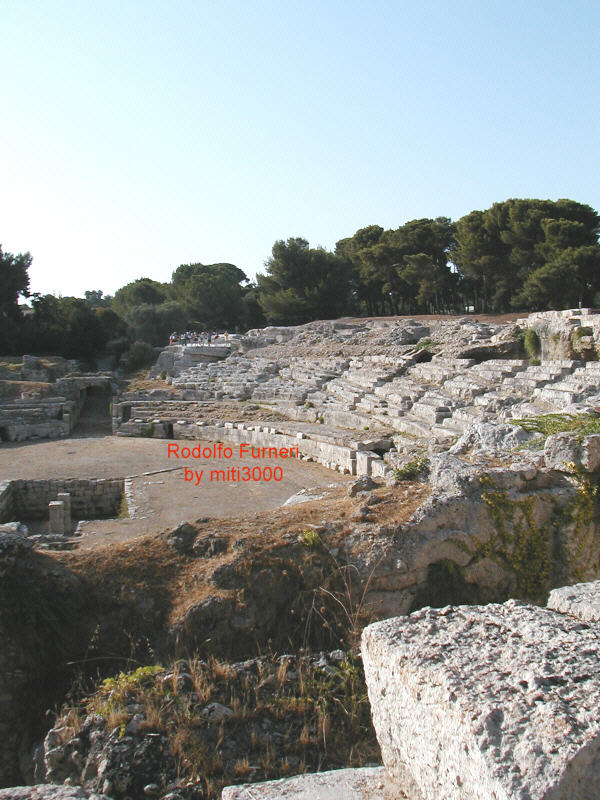
L’Anfiteatro Romano di Siracusa è orientato da N. - O. a S. – E. Mentre la parte rivolta a Nord fu scavata nella roccia, la parte Sud fu costruita con blocchi di pietra. Gli scavi di questo edificio, di cui oggi si può ammirare solo la parte più bassa, furono fatti nel 1839. Il suo asse maggiore è lungo 140 metri, quello più corto 119 metri ed è perciò il più grande fra quelli esistenti in Sicilia. Esso presenta due ingressi, uno sulla curva Nord, l’altro sulla curva Sud. Al centro dell’arena c’era una costruzione coperta collegata, tramite un sotterraneo, all’esterno della curva Sud. Attraverso questo sotterraneo, venivano introdotte nell’arena tutte le cose occorrenti alla realizzazione degli spettacoli. Dietro il muro che racchiudeva l’arena c’era un corridoio sotterraneo, la crypta, e sopra questa i posti a sedere per i personaggi più importanti. A livelli più alti, altri due corridoi permettevano agli spettatori di raggiungere le gradinate.
Tempio di Athena
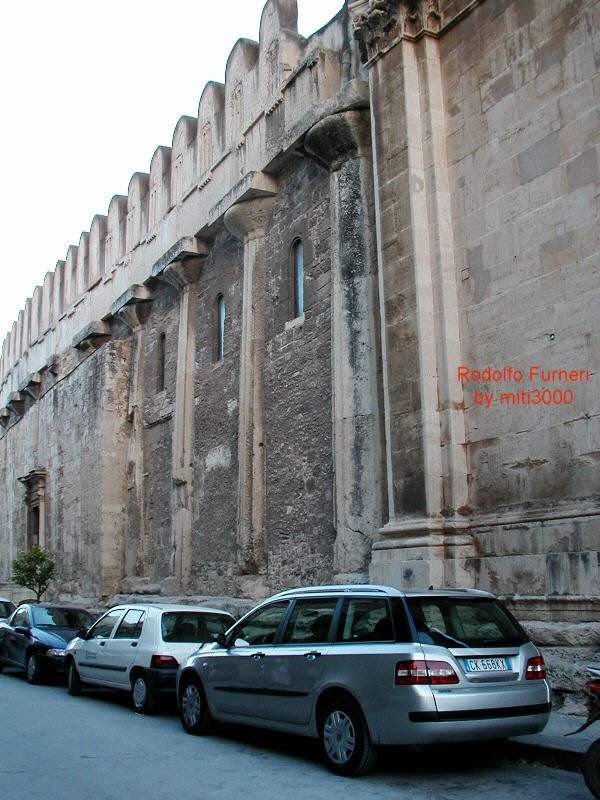
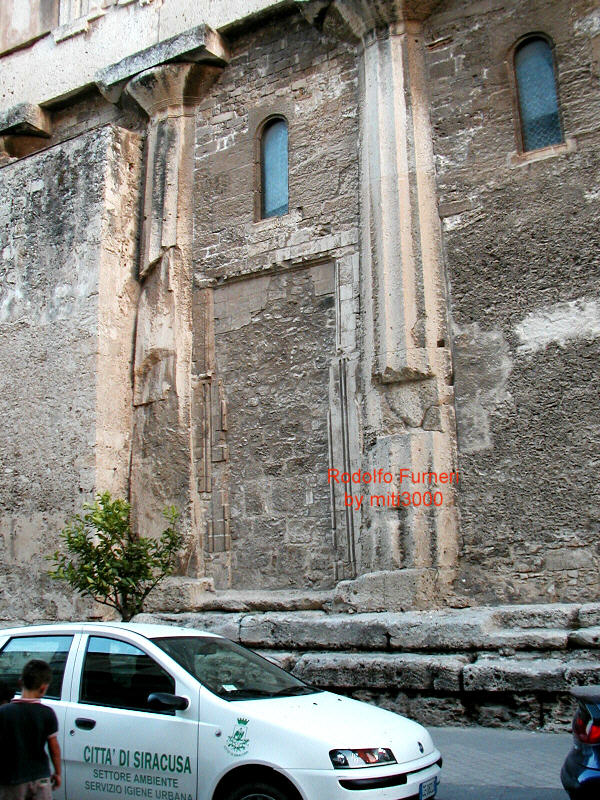
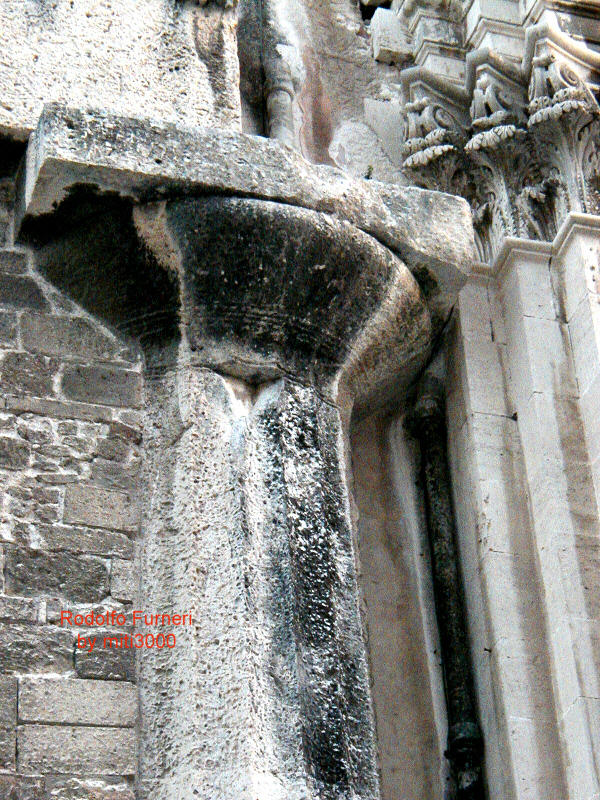
Nello stesso sito della attuale Cattedrale di Siracusa, tra il 480 ed il 470 a. C., Gelone, per celebrare la vittoria di Himera sui Cartaginesi, fece costruire un tempio dedicato alla dea Athena (Athenaion). Era un tempio periptero, cioè su tutti e quattro i lati circondato da colonne, 6 sui lati più corti e 14 sui lati più lunghi. Era doppiamente IN ANTIS (cioè con pronao ed opistòdomo),(vedi la struttura di un tempio) costruito in pietra calcarea intonacata e dipinta. La sua trabeazione presentava triglifi e metope lisce. L’interno era decorato con pitture e la porta era impreziosita da decorazioni in oro e avorio. Sul frontone splendeva uno scudo d’oro che era la prima cosa che vedeva di Siracusa chi la stesse raggiungendo dal mare. Un acroterio sul frontone era costituito da una statua in marmo di Nike (la dea della vittoria). Verso la fine del VI secolo d. C., l’Athenaion fu trasformato in basilica cristiana a tre navate e nel secolo successivo divenne la Cattedrale di Siracusa. Sotto gli Arabi (dall’878 in poi), la Cattedrale cristiana fu quasi sicuramente trasformata in moschea, per poi tornare ad essere una chiesa cristiana dopo la conquista normanna. Il campanile fu distrutto, una prima volta, nel 1542 da un terremoto e, dopo essere stato ricostruito, rovinò di ancora nel 1580 per effetto di un fulmine. Nel XVII secolo, all’ interno della Cattedrale furono costruite le cappelle del Sacramento e del Crocifisso. Il terremoto del 1693 fece crollare la facciata normanna e, per la terza volta, il campanile. Nella prima metà del XVIII secolo fu iniziata la costruzione della Cappella di Santa Lucia e fu rifatta la facciata su progetto di Andrea Palma.
V. Accarpio
Fountain of Arethusa
Located in the southwestern part of the island of Ortigia, it has been known since ancient times. Over the centuries, its fame has grown greatly, along with the myth that has always accompanied it. Its history is intimately linked to that of Syracuse, since its foundation in 734 BC. C., ever since Archias of Corinth, of the Heraclid family, according to Thucydides, received a prophecy from the Oracle indicating the place where he should found a new city, once he abandoned his "polis": a spring where the waters of a nymph flowed next to the sea on a small island of the great Trinacria.
It was a time when, due to the narrowness and poverty of the territory, many people left Greece in search of new spaces, abandoning a territory that, although splendid from a landscape point of view, offered little in the way of food.
The scarcity of plains and the abundance of mountainous and rocky terrain allowed only simple subsistence pastoralism, leaving the coasts with greater potential for fishing. The Greeks, driven by curiosity and, above all, necessity, emigrated in large numbers along the Mediterranean, founding numerous cities, spreading their culture and sowing knowledge across vast areas far larger in size than the very modest Greece.
It is interesting to note how, after the initial moments of bloody conflict, they managed to blend in with the local populations, transforming their customs and traditions—in short, their way of life—for the better, while never neglecting their ties with the motherland, which remained frequent and important.
They were highly skilled navigators, trained in the great Hellenic naval school, with a profound knowledge of the winds that make the Mediterranean a sea that is sometimes difficult to navigate, even in summer, when the season seems most favorable. Sudden storms surprised the crews, and even though navigation took place mostly during the day and close to the coast, that is, in sight, ships at the mercy of the waves often foundered on the rocks of the coastal strip. This is evidenced by the richness of the seabed, a paradise for divers and passionate archaeologists.
Priceless treasures, especially for their historical and documentary value, still lie on many seabeds, despite a large number of artifacts already being safely stored in museums, along with, unfortunately, another quantity, perhaps even greater, lost due to the spoils of unscrupulous predators who engaged in vile trade.
The prophecy, we were saying, spoke of a small island of the larger Trinacria and a prodigious source of fresh water a few steps from the sea, a visible manifestation of the mercy of a goddess who had reborn a nymph in the form of a spring.
The myth of Arethusa is one of the oldest and most beautiful that Greek culture has handed down to us, and despite the passing of decades, it still fascinates for the mixture of love and pain that characterizes the story of the two protagonists.
The story has all the hallmarks of a great love story. There are two protagonists: Arethusa, handmaiden of Artemis, the goddess of the hunt, and Alpheus, god of a river, son of Oceanus, who is madly in love with the young nymph. According to the myth, one day Arethusa immersed herself in the river's waters because of the heat, and Alpheus, who lived on its banks, fell in love as soon as he saw her. Frightened, Arethusa fled, calling upon Artemis, who, to save her, transformed her into a spring, causing it to flow on the island of Ortygia. Alpheus, distraught with grief, transformed himself into a river and, crossing the bottom of the Ionian Sea, resurfaced right next to Arethusa, mixing his waters with those of his beloved nymph. Nearby, in fact, there is another spring called the Eye of Zillica, which popular imagination has always believed to be the presence of Alpheus.
According to another version, Arethusa fell from the coast of Elis during her escape and was transformed into a spring after her death. I, who remain an incurable romantic, like to remember the version, I believe by Shelley, according to which Arethusa and Alpheus were two young lovers. One unfortunate day, Arethusa fell from a cliff into the sea and died, but was transformed by Artemis into a spring, a source right on Ortygia. Alpheus' grief moved Zeus, who transformed him into a river, thus allowing him, flowing beneath the Ionian Sea, to reach Arethusa and mix his waters with those of his beloved nymph.
The myth of Arethusa symbolizes, in fact, the strong bond that united this Greek colony to the motherland and the Syracusans' desire to emphasize this belonging beyond time and space. Theocritus in his "Syracusan Women" emphasizes this belonging by having women say they were proud to descend from colonists from Corinth and, therefore, accustomed to speaking the Greek language.
Further confirmation of this profound bond is evidenced by the fact that it was believed true that when sacrifices were performed at Olympia, the spring waters were tinged red. Syracuse, among others, was the Greek colony that managed to develop best, achieving a splendor and power comparable to, or in many cases superior to, that of many Greek cities. Art, philosophy, science, and culture in general in this city were favored by enlightened tyrants, even Dionysius the Elder, who participated in literary competitions in Greece with tragedies written by himself.
Over the centuries, the place and the myth have inspired dozens of poets and writers such as Ovid and Silius, Virgil and Pindar, Pindemonte, Gregorovius, D'Annunzio, Quasimodo, Carducci, Milton, Shilley, André Gide, and Cicero, to name a few. They drew inspiration from this place and this myth, as if, looking at their reflections in the spring's waters, they were enchanted by a subtle magic. In one of his poems, Giosuè Carducci expresses himself thus:
"Love, love, the waters whisper
and Alpheus calls Arethusa to his green bridal chambers"
and Salvatore Quasimodo:
"I do not seek a place of childhood
and following the river under the sea,
even before its mouth in Arethusa,
to tie the broken
cord of arrival."
For the ancients, water was a precious commodity, and especially for the first settlers who had crossed the sea for days and weeks, coming from lands notoriously poor in springs and rivers, the discovery of freshwater sources so close to the sea must have seemed like a clear manifestation of the benevolence of some deity.
For the English Admiral Nelson, it was even a lucky place, because, after supplying his ships with water, he defeated Napoleon's French fleet at Aboukir in the Mediterranean waters, off the coast of Egypt.
The spring, also described by Arab geographers such as Edrisi, who lived in the 12th century, along with other nearby springs, was used for centuries for tanning hides. Due to earthquakes and neglect, the site was reduced to a squalid washhouse. Over time, it has undergone numerous renovations. Its current appearance, with its remarkable environmental charm, is due to the last renovation in 1843, under the administration of Mayor Borgia.
The body of water, in a semicircular basin, opens visually towards the sea, bordered by slender, elegant iron railings; the bottom gurgles with the constant influx of freshwater. Greenery reigns supreme thanks to papyrus and aquatic plants, among which freshwater fish swim in abundance, while pigeons flutter awkwardly above or at the edges. It springs just over half a meter above sea level and, like all springs, is naturally subject to seasonal variability.
Locally, it is called "'a funtana 're pàpiri" (the duck fountain) because of the birds and swans that parade like a catwalk, gliding and floating on its waters.
In fact, it is one of the numerous natural springs that characterize the entire coast south of Syracuse, the result of the generous Hyblean aquifer, which accumulates large quantities of water during the rainy season. Releasing it gradually throughout the year, it creates numerous springs near the sea, some of which are famous, such as the one that gives rise to the short Ciane River, which flows into Porto Grande opposite the island of Ortigia. Another location fifteen kilometers south of Syracuse is even called Fontane Bianche (White Fountains) for the presence of freshwater springs that flow from pale rocks lapped by the sea.
The Hyblean region, the mountainous massif in southern Sicily with modest peaks (Mount Lauro 984 meters above sea level), encompasses three provinces: Syracuse, Ragusa, and Catania. Of calcareous origin, rich in an incredible quantity of fossils, it has been subject to karst phenomena. Over time, this process transformed the insoluble calcium carbonate into bicarbonate, which dissolved in the filtering water, leaving large, empty internal chambers, making the whole thing resemble a giant Swiss cheese. This allowed, and still allows, a slow flow toward the sea of all the waters that pass through it at depth.
A territory of enormous historical and cultural importance, the natural home of numerous populations and important archaeological sites, declared a UNESCO World Heritage Site, it originates from the Mediterranean seabed millions of years ago, uplifted by the Alpine orogeny.
The source, as we have already mentioned, rises on the island of Ortigia, about a kilometer long and of great strategic importance, featuring two natural harbors: the first, the large one, for commercial and military use, and the second, smaller one, for fishing and shipbuilding. Here, the remains of the Arsenal are still visible, where Syracusan ships were built, some of which have gone down in navigational history, such as the one built by Archimedes, which to this day is considered the largest of antiquity. A sort of flagship, a kind of catamaran with two twin ships, joined by transverse decks, it could hold an incredible number of soldiers and cargo.
Archias, the founder of Syracuse, found the island already inhabited by the Sicels, and his task must have been arduous because, although they were not a particularly warlike people, they were ill-adapted to this new situation that drove them from such a delightful place, coveted by many later populations. Every corner, in fact, hides profound signs of the past. The subsoil, moreover, is a veritable goldmine. Beneath already famous buildings lie vestiges of ancient Syracuse, such as the Ionic temple located beneath the splendid Palazzo Vermexio, seat of the municipality. Ortigia is an island that preserves, after having mixed them, all the imprints of the cultures of the peoples who conquered it: the Greeks, the Romans, the Byzantines, the Arabs, the Normans, the Angevins, the Aragonese, and the Swabians.
Few places in the world can boast such a concentration of remnants of civilizations that, especially in the Mediterranean, have expressed their vitality, contributing to the development of the modern world.
A light that filters through the narrow streets and small squares, almost hidden between the buildings that loom tightly over them, creates striking contrasts of brightness on sunny days, with the depth of their shapes. The buildings overlooking the Marina del Porto Grande sparkle with their soft reds in the afternoon, which gradually turns into evening. Light and shadow here seem to be the protagonists of a titanic battle that will never have a winner, but which allows, at sunset and especially near the spring, panoramas of profound charm, a spell that fascinates and will never be forgotten by those who have had or will be fortunate enough to admire them.
Tino Insolia
The amphitheater
From the Greek ἀμφί - Amphi’ and θέᾱτρον - The’atron = theater on both sides) is not a Greek creation, but an Italic one, intended to host gladiatorial combats, hunts, and naval battles. In the center of the structure was the arena, reserved for the fighters and surrounded by a wall, the podium, from which the steps that formed the cavea began. The stands, intended for the spectators, were divided into sectors by steps that each led to a door (vomitorium = exit). The highest part consisted of a portico closed on the outside and with a colonnade on the inside. Two doors opened onto the arena: one for the entrance of the gladiators and one for carrying away the bodies of those who were killed. The underground areas housed the wild beasts. Each amphitheater had rooms for training gladiators, a morgue for those who were killed, a kitchen, and other services.
The Roman Amphitheater of Syracuse is oriented from NW to S-E. While the north-facing section was carved into the rock, the south section was built with stone blocks. Excavations of this building, of which only the lower section can be admired today, were carried out in 1839.
Its longest axis is 140 meters long, the shortest 119 meters, making it the largest in Sicily. It has two entrances, one on the north curve and the other on the south curve. At the center of the arena was a covered building connected, via an underground passage, to the outside of the south curve. Through this passage, all the materials needed for the performances were brought into the arena. Behind the wall enclosing the arena was an underground corridor, the crypta, and above it were the seats for the most important figures. At higher levels, two additional corridors allowed spectators to reach the stands.
Temple of Athena
On the same site as the current Cathedral of Syracuse, between 480 and 470 BC, Gelon, to celebrate the victory of Himera over the Carthaginians, built a temple dedicated to the goddess Athena (Athenaion). It was a peripteral temple, that is, surrounded on all four sides by columns, six on the shorter sides and fourteen on the longer ones. It was doubly IN ANTIS (that is, with a pronaos and an opisthodomos) (see the structure of a temple) built of plastered and painted limestone. Its entablature featured triglyphs and smooth metopes. The interior was decorated with paintings, and the door was embellished with gold and ivory decorations. On the pediment shone a golden shield, which was the first thing anyone approaching Syracuse saw from the sea. An acroterion on the pediment featured a marble statue of Nike (the goddess of victory). Towards the end of the 6th century AD, the Athenaion was transformed into a Christian basilica with three naves and in the following century it became the Cathedral of Syracuse. Under the Arabs (from 878 onwards), the Christian cathedral was almost certainly transformed into a mosque, only to return to being a Christian church after the Norman conquest. The bell tower was destroyed for the first time in 1542 by an earthquake and, after being rebuilt, collapsed again in 1580 by lightning. In the 17th century, the chapels of the Sacrament and the Crucifix were built inside the cathedral. The 1693 earthquake caused the Norman façade to collapse and, for the third time, the bell tower. In the first half of the 18th century, construction of the Chapel of Saint Lucy began, and the façade was rebuilt according to a design by Andrea Palma.
V. Accarpio