Colonizzazione greca e fondazione di Siracusa
La colonizzazione greca, sviluppatasi fra l’VIII ed il VI sec. A. C., portò la civiltà greca in una vasta area dell’ Italia meridionale ed in Sicilia. Di questo fenomeno ci sono rimaste numerose e preziose testimonianze costituite dai templi, dai teatri, dalle mura di fortificazione, dalle statue, dalle ceramiche, dalle monete, ecc.
“La parola greca da noi abitualmente tradotta“colonia“ è apoikia, che significa “emigrazione… ciascuna di esse (“colonie”) era una comunità greca indipendente, non una colonia nel senso tradizionalmente attribuito alla parola. E siccome il movimento era una risposta a difficoltà demografiche e agricole, le nuove comunità stesse erano insediamenti agricoli, non centri commerciali (a differenza delle colonie fenicie dell’occidente ).
Per la stessa ragione gli aristocratici della maggiore fra le nuove comunità, Siracusa, erano chiamati Gamoroi,“ coloro che si spartiscono la terra, i proprietari fondiari“ (mentre gli indigeni ridotti in schiavitù e comunque i lavoratori della terra erano chiamati Kyllirioi). Le relazioni fra la colonia e la città madre non avevano mai una base commerciale né altrimenti imperialistica, proprio perché le “colonie” erano indipendenti fin dall’ inizio, politicamente ed economicamente, nel complesso esse mantenevano per lunghi anni relazioni strette e amichevoli con la città madre. (Finley, Gli antichi Greci, Einaudi, 1965 ).
Ma che cosa induce tante migliaia di persone ad abbandonare la Grecia, ad emigrare e fondare nuove città lontano dalla loro terra d’ origine ?
Con il passaggio dai regimi monarchici a quelli aristocratici, le terre finirono in mano dei più ricchi ed i poveri diventarono sempre più poveri.
Uno dei principali motivi della colonizzazione fu appunto quello di smaltire in qualche modo l’eccessivo numero dei contadini inurbati ed in ogni caso settori eccedenti e malcontenti della popolazione.
Verso la metà dell’ VIII secolo a. C. comincia questa fuga dalla Grecia e la fondazione delle colonie greche in Sicilia e nell’ Italia meridionale.
I luoghi in cui più spesso vengono fondate le colonie sono quelli in cui esistevano già degli scali commerciali. Spesso le prime colonie fondarono a loro volta delle altre città.
Quasi sempre la città madre forniva ai coloni i mezzi necessari e designava il capo della spedizione (l’ecista) che poteva anche svolgersi in diverse fasi e talvolta veniva consentita dalle popolazioni autoctone dietro qualche compenso, mentre altre volte si creavano dei rapporti conflittuali.
La seconda delle città greche in Sicilia fu Siracusa, fondata da un gruppo di cittadini di Corinto guidati dall’ecista Archia verso il 732 a. C.
Sulla storia della fondazione di Siracusa, Strabone, che visse 700 anni dopo il fatto, riferisce che “Archia, navigando da Corinto, fondò Siracusa circa nello stesso periodo in cui furono fondate Nasso e Megara… Archia, continuando nel suo viaggio, incontrò alcuni Dori… che si erano separati dai coloni di Megara; li prese con sé e fondarono insieme Siracusa”.
Di solito le città venivano costruite secondo una pianta ortogonale, cioè con strade ( piuttosto strette ) che si incrociavano ad angolo retto. Il centro della città era costituito dall’Agorà, una piazza in cui si svolgevano tutti gli affari più importanti.
Gli artisti, architetti, scultori, pittori, che operarono nelle città italiote, di solito, replicarono i modelli stilistici usati nella loro città d’ origine, ma spesso seppero apportare a questi modelli delle interessanti innovazioni.
V. Accarpio
I PERSONAGGI:
- Mosco di Siracusa (II secolo a.C.), poeta. Gli sono attribuiti alcuni frammenti di componimenti pastorali ed erotici di ispirazione teocritea, tra i quali in particolare l'epillio Europa, in cui viene narrata la nota favola di Zeus trasformatosi in toro per amore della fanciulla di Tiro, e l'idillio Eros fuggitivo, nel quale si racconta della promessa, fatta da Afrodite, di una notte d'amore a chi le avesse riportato vivo il figlio scomparso. Degli interessi retorici e degli studi grammaticali di Mosco ci è pervenuto soltanto il titolo di una sua opera, Sulle parole rodie.
- Gelone (Gela 540 ca. - Siracusa 478 a.C.), tiranno di Gela (491-485 a.C.) e di Siracusa (485-478 a.C.). Comandante della cavalleria di Ippocrate, precedente tiranno di Gela, gli succedette nel 491 a.C. Nel 485 a.C., approfittando di lotte interne a Siracusa, si impadronì anche di questa città, lasciando il governo di Gela al fratello Gerone I. In breve tempo Gelone divenne potentissimo ed estese il suo dominio su gran parte della Sicilia orientale. Nel 481 a.C. durante la seconda guerra persiana, Atene e Sparta gli chiesero aiuto contro i persiani; Gelone accettò pretendendo però il comando dell'esercito, condizione che non venne accolta. Nel 480 a.C. sconfisse i cartaginesi che, intervenuti col pretesto di appoggiare l'ex tiranno di Imera, Terillo, nella riconquista della città, minacciavano in realtà l'egemonia sull'isola delle città greche alleate di Siracusa e Agrigento. La vittoria di Imera rafforzò invece l'influenza sulla Sicilia di Gelone, che morì due anni dopo, lasciando Siracusa al fratello Gerone I di Gela.
- Agatocle (? 360 ca. - Siracusa 289 a.C.), tiranno di Siracusa (316-289 a.C.), assunse forse nel 304 a.C. il titolo di re. Proseguì la strategia offensiva siracusana contro i cartaginesi, dai quali venne sconfitto a Ecnomo nel 310 a.C.; portò quindi la guerra in Africa, minacciando la stessa Cartagine, con la quale dovette però patteggiare la pace. La sua influenza si estese all'intera Sicilia, a eccezione di Agrigento. Per sua volontà, alla sua morte il governo della città venne affidato al popolo siracusano.
- Gerone II (Siracusa 306-215 a.C.), re di Siracusa (265-215 a.C.). Di oscure origini, mascherate poi simulando un'illustre discendenza da Gerone I, fu luogotenente di Pirro nelle guerre contro i cartaginesi di Sicilia; assunse successivamente il comando dell'esercito siracusano, impadronendosi di fatto della città. Nemico dei mamertini, i mercenari campani che avevano occupato Messina, nonostante un primo insuccesso li sconfisse a Milazzo nel 265 a.C., dopodiché venne acclamato re di Siracusa. Quando nel 264 a.C. i romani intervennero a Messina in favore dei mamertini (nella prima guerra punica) Gerone si alleò dapprima con i cartaginesi per contrastare l'intervento romano, per poi (263 a.C.) patteggiare con i romani stessi un trattato a durissime condizioni economiche, che vennero condonate solo nel 248 a.C. Da allora fu fedele a Roma, soprattutto in chiave anticartaginese, pur mantenendo buoni rapporti con altri sovrani, in particolare i Tolomei d'Egitto. Sovrano illuminato, favorì le arti e le lettere e instaurò un sistema tributario (lex hieronica) tanto efficiente che i romani stessi lo imitarono. Gli successe il giovane nipote Geronimo.
- Teocrito (Siracusa 310 ca. – 250 ca. a.C.), poeta, creatore del genere pastorale. Poche sono le notizie biografiche, che perlopiù si ricavano dalle sue opere: nacque a Siracusa, dove trascorse la giovinezza, e visse in questa città probabilmente fino al 275-274 a.C., quando compose un idillio intitolato Le Grazie con il quale si rivolgeva a Gerone II per ottenerne il favore e la protezione. Lasciò poi la patria e si trasferì ad Alessandria, dove fra il 274 e il 270 a.C. scrisse l’Encomio a Tolomeo, carme dedicato al re d’Egitto Tolomeo II Filadelfo di cui esaltava la generosità. Entrò anche in contatto con Callimaco, di cui condivise la poetica (come è attestato dall’idillio Le talisie), senza tuttavia cimentarsi come lui nell’attività di poeta-filologo. Trascorse il resto della vita fra Alessandria e l’isola di Kos, notevole centro culturale, patria di poeti famosi come l’elegiaco Fileta. Rimane sconosciuto l’anno della morte, che tuttavia si colloca con certezza dopo il 260 a.C.
- Gerone I (? - 466 a.C.), tiranno di Siracusa (478-466 a.C.), successe al fratello Gelone. Gerone era conosciuto per il suo valore militare e prima dell'ascesa al trono si era distinto nella battaglia di Imera nel 480 a.C. Fece di Siracusa la principale città siciliana e fondò la città di Etna (475 a.C.). La sua vittoria sugli etruschi a Cuma, nel 474 a.C. preservò l'indipendenza dei coloni greci in Italia. Nel 472 a.C. l'esercito siracusano sconfisse Trasideo, re di Akrágas (la moderna Agrigento) e Gerone divenne il signore supremo della Sicilia. Era noto per la sua crudeltà, ma anche per la protezione accordata a poeti e filosofi.
- Archimede (Siracusa 287-212 a.C.), matematico e fisico. Fu uno dei più grandi studiosi di matematica dell'antichità, si interessò di diversi settori della fisica e fu un geniale inventore. Studiò ad Alessandria d'Egitto, dove fu forse allievo di Euclide.
- Dionisio il Vecchio (432-367 a.C.), tiranno di Siracusa dal 405 al 367. Di umili origini, fu un funzionario governativo prima di conquistare il potere illegalmente. Nel 404 strinse una pace con i cartaginesi, che avevano occupato quasi tutta la Sicilia; intraprese quindi una serie di campagne militari sul territorio siciliano e nella Magna Grecia, tentando, a partire dal 398, di cacciare i cartaginesi dall'isola, riportando inizialmente alcuni successi. Servendosi dell'aiuto di mercenari, Dionisio fece di Siracusa la città più potente dell'isola.
- Epicarmo (540 ca. a.C. - 450 ca. a.C.), commediografo greco, nato secondo la tradizione a Kos, secondo altre fonti a Siracusa, certamente cresciuto a Megara, in Sicilia. A partire dal 484 a.C. Epicarmo visse a Siracusa, dove godette del mecenatismo di Gelone e Gerone I.
Non volendo continuare ad allungare questa lunga lista, mi limito ad aggiungere solo alcuni dei personaggi illustri ospitati dalla città di Siracusa:
Simonide di Ceo - Platone - Lisia - Bacchilide - Pindaro - Calamide
Chi di voi avrà la fortuna di visitare questa città, non deve assolutamente perdersi una sosta alla mitica pasticceria BRANCATO sita in via Grottasanta, 219.
Iniziamo con Castello Eurialo
Fatto costruire da Dionisio il Vecchio tra il 402 e il 397 a.C., prende il nome dal greco Euryelos per la sua forma di "chiodo dalla grossa testa". Occupa un'area di 15.000 mq. e si suddivide in due parti: il mastio con gli alloggiamenti militari e il recinto.
Presenta tre prospetti: uno occidentale che rappresenta anche la parte frontale del castello, mentre gli altri due, meridionale e settentrionale, si uniscono formando la punta del "chiodo", rivolta ad est verso il mare. Su quello frontale campeggiano cinque torri quadrate, alte probabilmente all'epoca della loro costruzione quindici metri, dietro le quali macchine belliche, le baliste, permettevano di lanciare sassi e altri materiali offensivi sui nemici.
Antistanti alle torri si possono ancora notare i resti di un cuneo, le cui mura rappresentavano un ulteriore elemento difensivo e tre fossati. Il primo lungo sei metri e profondo quattro è, oggi, completamente interrato. Il secondo, posto a ottantasei metri dal primo, ha una lunghezza di cinquanta metri, una larghezza di ventidue e una profondità di sette. Il terzo fossato, infine, a ridosso delle torri è lungo ottanta metri, largo diciassette e profondo nove. E' il più importante perché collega tutti i reparti difensivi.
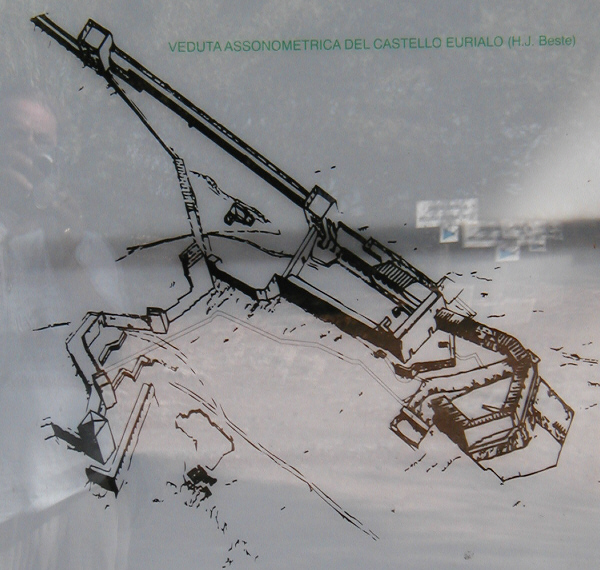
La fortezza era provvista di ingegnose opere in grado di assicurare una tenace resistenza. Lungo il fianco settentrionale si può, infatti, ammirare una porta d'accesso, protetta con mura ad imbuto, nascosta da altre disposte trasversalmente, mentre a sud ci sono i resti di tre pilastri che sostenevano il ponte levatoio.
La presenza di tre grosse cisterne e le studiate soluzioni difensive, come le doppie mura a sud, fanno intuire i lunghi periodi di resistenza che questa fortezza poteva garantire.
L'orientamento del Castello, disposto prevalentemente lungo l'asse est-ovest, era stato studiato in modo tale che i difensori, almeno sul fronte principale, non avessero il sole negli occhi al mattino, quando presumibilmente i nemici, dopo una notte di riposo, avrebbero potuto tentare un nuovo assalto. Nel pomeriggio la stanchezza poteva consigliare agli assedianti di desistere, mentre di notte i tre fossati sicuramente costituivano un ottimo deterrente. Nella fioca luce notturna, infatti, essi rappresentavano trappole mortali.
All'interno del Castello, dietro le cinque torri, un cortile di epoca bizantina fungeva da caserma. La truppa nel sicuro delle gallerie e dei camminamenti poteva spostarsi, grazie ad un ingegnoso sistema di scale e di gallerie lungo 480 metri, con la massima celerità da un punto all'altro a secondo delle necessità difensive.
La necessità storica
Per una città come Siracusa posta sul mare, l'arrivo improvviso di una flotta nemica poteva rappresentare un pericolo gravissimo, magari non più in grado di essere combattuto.
Se per terra mura poderose potevano difendere la città e dare modo ai suoi abitanti di resistere anche per lunghi periodi, un nemico agguerrito che si fosse presentato all'improvviso nel Porto Grande difficilmente sarebbe stato rintuzzato e ricacciato in mare aperto o distrutto sul posto.
La via del mare, inoltre, poteva rappresentare l'ultima possibilità di fuga nei confronti di un nemico che per terra avesse travolto le ultime difese. Era, perciò, indispensabile scrutare soprattutto l'orizzonte marino per prevenire eventuali attacchi e organizzare una migliore difesa. Ortigia, la piccola isola sulla quale Siracusa era stata fondata nel 734 a.C. da coloni corinzi, alta meno di cinquanta metri sul livello del mare, non poteva garantire che la visione di poche miglia marine. Ecco, perciò, l'impellente necessità di avere un posto d'osservazione sufficientemente alto e sufficientemente vicino alla città.
Dalla Marina, l'attuale passeggiata in Ortigia, lo sguardo abbraccia solo l'ampio e luminoso panorama di questa splendida insenatura, partendo proprio dalle ripide coste del promontorio, denominato Capo Murro di Porco, poste di fronte al Castello Maniace, estremo lembo orientale dell'isola. Fu questo notevole restringimento all'uscita del porto che, grazie ad alcune navi legate tra loro da potenti catene, permise ai Siracusani di chiudere la via di fuga alla flotta ateniese, arrogantemente alla fonda in quelle acque, e di distruggerla nel 413 a.C. durante la seconda guerra del Peloponneso.
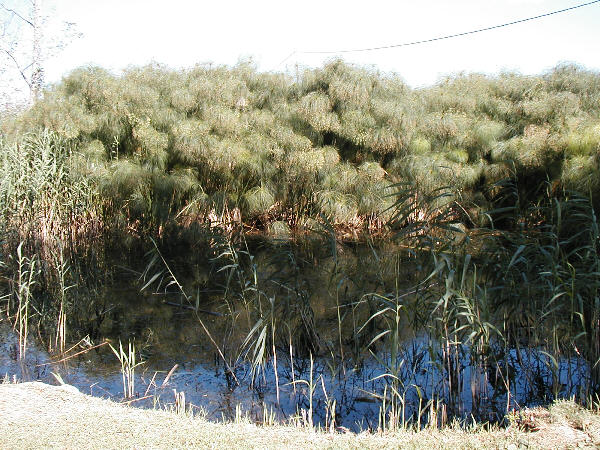
La vista prosegue lungo la linea sottile dei lidi sabbiosi, scivolando tra i grigi canneti fino alle foci contigue dell'Anapo e del Ciane, orlate dai ciuffi verdi degli ombrellati papiri.
L'entrata nel tranquillo e sicuro porto doveva rappresentare un momento felice ed esaltante per gli equipaggi, stanchi per giorni o settimane di navigazione. Siracusa non offriva solo uno dei migliori rifugi naturali, tra l'altro rari, lungo la costa orientale della Sicilia; la città, capitale della Magna Grecia era, infatti, uno dei più importanti empori commerciali del Mediterraneo e, quindi, piena di attrattive di tutti i generi.
Non bisogna dimenticare, inoltre, che Siracusa rappresentava il maggiore avamposto greco verso occidente e che manteneva con la madrepatria intensissimi rapporti culturali, politici ed economici.
Acque sicure dall'imperversare d'improvvise tempeste, specie nel periodo invernale, accoglievano legni greci o di altre azioni venuti a commerciare.
La città, grazie alla sua posizione e all'audacia dei suoi cittadini, riuscì a svilupparsi bene, raggiungendo il massimo splendore sotto il regno di Dionisio il Vecchio, durato dal 405 al 367 a.C..
La storia del Castello s'intreccia intimamente con la figura di questo tiranno, odiato e temuto personaggio della Storia, simbolo di cieco assolutismo, dispotismo e culto della persona, antesignano di Luigi XIV, il re Sole. Modelli che, purtroppo, sono stati copiati nel Novecento con risultati apocalittici nella loro brutale disumanità. La storia del Castello Eurialo inizia, quindi, alla fine del V secolo con l'opera instancabile di Dionisio, tesa a ricostruire e potenziare le difese della città, soprattutto in vista dell'inevitabile scontro con i Cartaginesi. Essi, infatti, avrebbero sicuramente malvisto il tentativo espansionistico di Siracusa, progettato con l'intento di risalire la profonda china istituzionale ed economica in cui la città era caduta in seguito alle guerre contro Atene e per contrasti interni tra Ermocrate e Dione, sfociati praticamente in una guerra civile.
Soprattutto le difese lungo il versante settentrionale si erano dimostrate essere il tallone di Achille nella guerra contro gli Ateniesi per la loro scarsa consistenza. Demostene, il generale comandante l'esercito ateniese, aveva facilmente occupato per ben due volte, l'alto colle dell'Epipoli dal quale era poi sceso verso la città per cingerla d'assedio.
A sud Siracusa era protetta, invece, dalla Natura. Le paludi Lisimelie, oggi bonificate e note con il significativo toponimo di Pantanelli, rappresentavano allora con la loro presenza un serio ostacolo al rapido movimento di truppe e di macchine belliche, oltre al pericolo incombente della malaria.
Secondo lo storico Diodoro Siculo, Dionisio iniziò a rinforzare le difese proprio sul lato nord, facendo erigere in soli venti giorni con l'aiuto di sessantamila uomini un muro lungo oltre cinquemila metri, traendo i materiali necessari dal generoso territorio degli Iblei. Alle spalle del Castello Eurialo, a circa tre chilometri in prossimità del bivio per Priolo e Floridia, uno spettacolare scenario quasi ci suggerisce il luogo della cava dalla quale i Siracusani probabilmente trassero i mastodontici parallelepipedi di calcare, necessari per la grande opera.
Un grande anfiteatro naturale, infatti, formato da numerosi gradini, resti delle antiche falesie marine, preceduto da una larga zona pianeggiante, induce a questa affascinante considerazione.
Spesso la fantasia colma le lacune della Storia. Nelle vicinanze, poi, del luogo l'effettiva presenza di alcune cave, che ancora oggi traggono dalle visceri degli Iblei materiali utili per l'edilizia, accresce la sensazione e la voglia di rivivere con l'immaginazione eventi che si sono svolti in tempi molto remoti. Naturalmente il muro, seppur poderoso, da solo non sarebbe bastato ad arginare l'assalto dei nemici, se lungo il suo svolgersi non ci fossero stati a supporto della sua difesa dei fortini. Essi erano collegati molto presumibilmente con la fortezza principale e cioè con il Castello Eurialo.
È bello rivivere, attraverso le parole di Diodoro Siculo (XIV 18,2-7) la descrizione della costruzione del muro settentrionale, lungo esattamente secondo le sue testimonianze 30 stadi attici, cioè 5580 metri, che congiungeva l'Epipoli al mare e a cui si sarebbe successivamente saldato il Castello:
«Avendo visto che durante la guerra con Atene la città era stata bloccata da un muro che andava da mare a mare, temeva, in casi analoghi, di venir tagliato fuori da ogni comunicazione con il territorio circostante: vedeva bene, infatti, che la località chiamata Epipole dominava la città di Siracusa. Rivoltosi ai suoi architetti, in base al loro consiglio decise di fortificare le Epipole con un muro, ancora oggi conservato nella zona intorno all'Exapylon (le " sei porte "). Questo luogo, rivolto a Settentrione, interamente roccioso e a picco, è inaccessibile dall'esterno. Desiderando che le mura fossero costruite con rapidità, fece venire i contadini dalla campagna, tra i quali scelse gli uomini migliori, in numero di 60.000, e li distribuì lungo il settore di muro da costruire. Per ogni stadio designò un architetto e per ogni pietra un mastro muratore, a ciascuno dei quali assegnò 200 operai. 6.000 gioghi di buoi erano impiegati nel luogo designato.
L'attività di tanti uomini, che si applicavano con zelo al loro compito, presentava uno spettacolo straordinario. E Dionigi, per stimolare l'entusiasmo di questa moltitudine, prometteva grandi premi a coloro che avessero terminato per primi, specialmente agli architetti, poi anche ai mastri muratori, infine agli operai. Egli stesso, con i suoi amici, assisteva ai lavori per intere giornate, ispezionando ogni luogo e facendo sostituire quelli che erano stanchi. In breve, rinunciando alla dignità del suo ufficio, si riduceva a un rango privato, e assoggettandosi ai lavori più pesanti, sopportava la stessa fatica degli altri: ne nacque di conseguenza una grande emulazione, e alcuni aggiungevano anche parte della notte alla giornata lavorativa. Tale era l'entusiasmo di quella massa di lavoratori. Di conseguenza, il muro fu terminato, al di là di ogni speranza, in 20 giorni: esso era lungo 30 stadi, e di altezza proporzionata, e così robusto da esser considerato imprendibile. Vi erano alte torri a intervalli frequenti, costruite con blocchi lunghi 4 piedi, accuratamente giuntati».
La visita del Castello
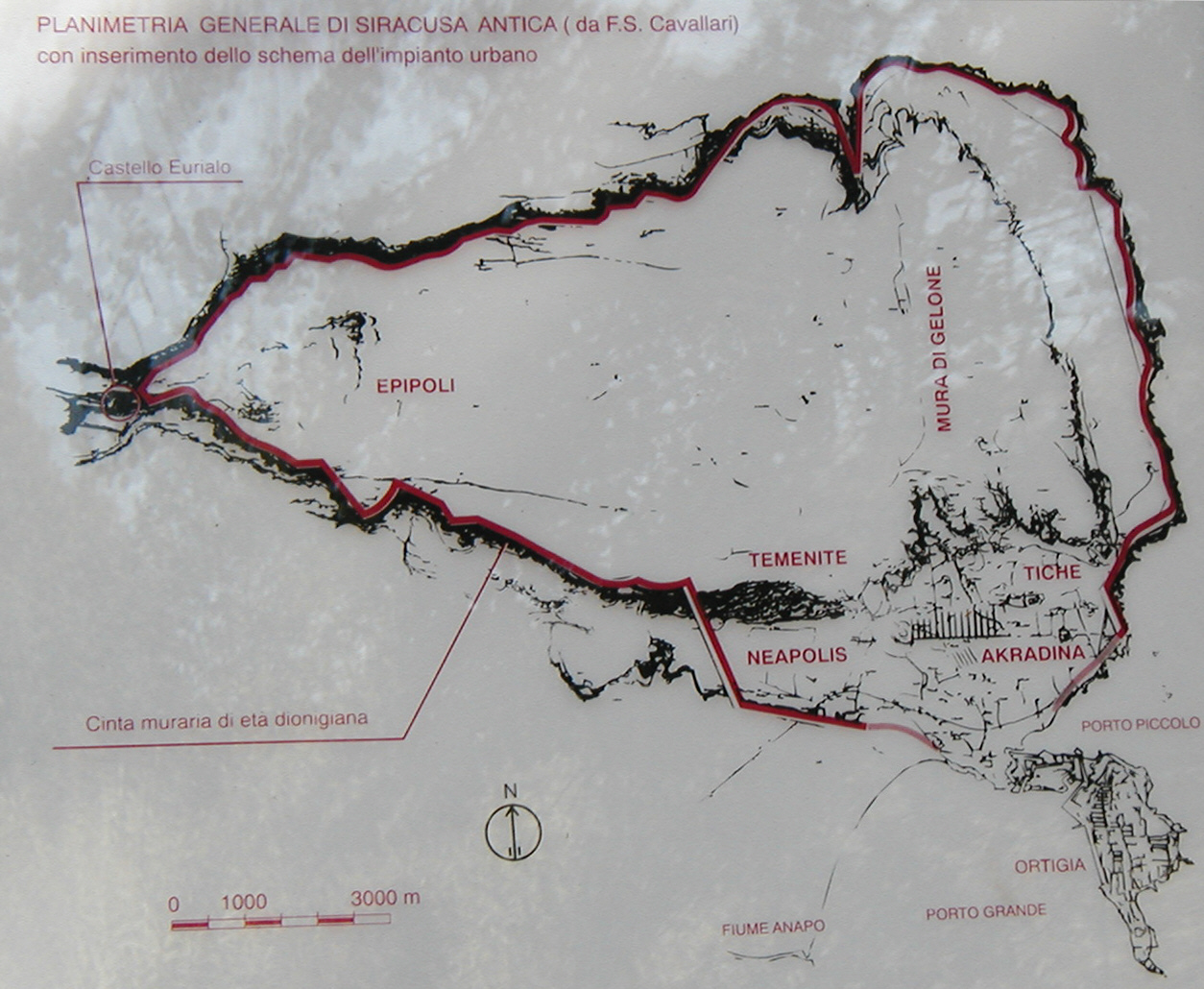
Ancora oggi, essa è un viaggio a ritroso nel tempo, capace di offrire intense emozioni. Costruito in un tempo relativamente breve, vista la vastità dell'opera, dal 402 al 397 a.C. proprio sull'Epipoli (dal greco "sopra la città") ad ovest di Siracusa, distante appena otto chilometri da Ortigia, è la più grande opera di ingegneria militare della Magna Grecia, il coronamento delle opere difensive volute da Dionisio, che riuscì così a saldare le mura settentrionali con quelle ad ovest della città, per uno sviluppo complessivo di circa trentadue chilometri.
La sua costruzione, come testimoniano i numerosi resti di abitazioni vicine, permise lo sviluppo di un grosso quartiere, l'Epipoli appunto, che insieme agli altri quattro Tyche, Neapolis, Ortigia ed Acradina, rappresentava l'intero territorio urbano, ampio e ben articolato. Secondo certe stime si valuta in oltre trecentomila persone la popolazione complessiva di allora.
Come nel nostro Medioevo, vicino al castello si raccolse una fitta popolazione. In tempi dove i nemici vittoriosi non andavano tanto per il sottile e, una volta effettuata la conquista, si lasciavano andare a saccheggi e massacri, la gente si sentiva protetta nella propria esistenza, nei commerci e nel proprio lavoro dalla rassicurante presenza delle armi. Senza contare che la fortezza, in caso di pericolo, avrebbe potuto anche accoglierli.
Provenendo da Ortigia e salendo verso l'Epipoli si ha la gradevole sensazione di una vista che si allarga, dominando un territorio sempre più esteso e un orizzonte sempre più lontano.
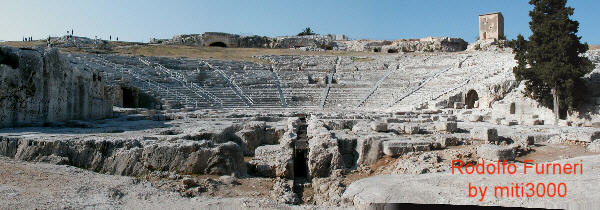
Superato il luogo dove si era sviluppato l'antico quartiere di Neapolis, sopra il Teatro Greco, ed una postazione dell'Aeronautica ormai in disuso, la strada ci conduce ad una delle porte di accesso alla città, lungo le mura occidentali, vicinissima al Castello Eurialo il cui profilo perimetrale meridionale vediamo torreggiare poco più in alto.
I resti delle vecchie mura accanto alla porta ci danno già l'idea del valore di questa cinta muraria. Alberi di ulivo, mandorli e carrubi, oltre a lentisco, lecci ed euforbie abbelliscono, ombreggiandolo, il ripido versante collinare che sale fino al fianco meridionale del castello.
Un ultimo chilometro, ancora alcuni brevi tornanti e finalmente si entra nello stretto difficile parcheggio. L'ingresso al sito, peraltro gratuito, è ombreggiato da un gruppo di pini a destra che nella calura del primo pomeriggio rappresentano un piccolo refrigerio. Custodi seduti e annoiati che sembrano far parte da secoli del paesaggio, nella loro discrezione, quasi non ti degnano di uno sguardo.
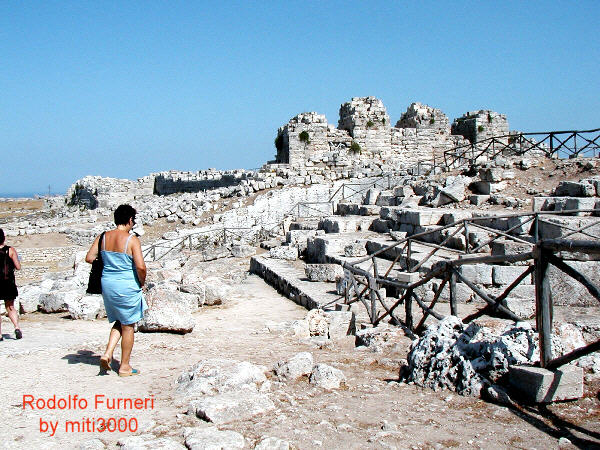
Superata anche questa piccola oasi di verde siamo finalmente di fronte a questo meraviglioso scenario. Se le "parole" in un celebre libro di Carlo Levi "sono pietre", parafrasando quel titolo, in questo luogo si può affermare che le pietre sono ridiventate parole, messaggi consegnati alla Storia dalla moltitudine di uomini che in questo posto vissero e morirono.
Le cinque torri si ergono quasi a puntellare un cielo pieno di una luminosità che ti pervade fino in fondo e ti cattura, facendoti sentire come una lucertola che avanza a passi misurati, crogiolandosi sui sassi scaldati dal sole. Di un biancore abbagliante ti si para davanti come una corazzata pronta a sparare, adagiata sul dorso del crinale che sale dal mare.
Da questa posizione s'intravede a destra la bassa valle dell'Anapo, mentre a sinistra le brutture industriali di Priolo ed Augusta deturpano un paesaggio meraviglioso, costituito dalla linea di costa che s'inarca verso il Golfo di Catania con l'Etna, maestoso e incombente sulla città. Ancora più in fondo la costa alta di Taormina e nei giorni di vento è visibile perfino la striscia sottile della Calabria.
È bello sostare ad ammirare gli spalti e i fossati antistanti. Tutta la visita del Castello, già di per sé faticosa per i continui saliscendi, andrebbe fatta senza premura, soffermandosi nei numerosi punti dove il gioco delle forme e gli spazi dilatati e immensi del cielo e della terra offrono sensazioni di profondo benessere.
Lontani da rumori, nel silenzio di queste mura si coglie la profonda sensazione di un benessere che ti pervade, senti solo la brezza che sale dal mare e fa oscillare i teneri culmi delle erbe già secche. I cardi spogliati ed arcigni sembrano soldati chiusi nelle loro armature di bronzo e nelle forme scultoree ed aguzze dei loro steli e delle loro spine.
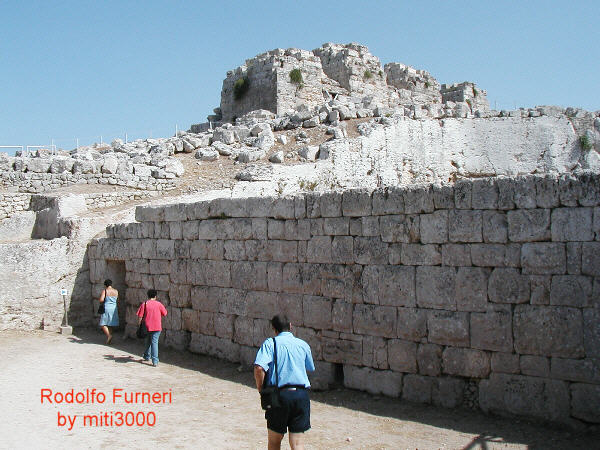
Penetriamo nel castello attraverso una porta presente sul fianco nord al livello del terzo ed ultimo fossato, il più grande, e ci sentiamo subito sprofondati in una realtà facilmente immaginabile.
Un corridoio, parallelo al fossato e scavato nella viva roccia a sinistra, mostra per tutta la sua lunghezza più finestre d'accesso con spioventi litici che, ombreggiando l'interno, permettevano al difensore nascosto di colpire e infilzare il nemico che, abbagliato dal sole, si fosse imprudentemente parato davanti.
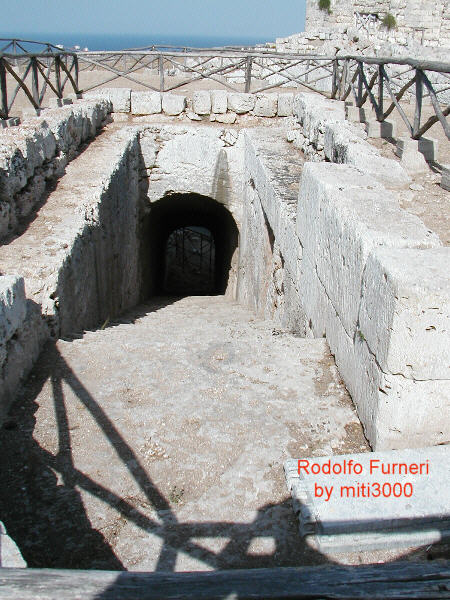
Ad un capo del corridoio a sinistra, l'inizio di una buia galleria, scatena la nostra fantasia su possibili passaggi segreti. Continuiamo a percorrerlo fino a quando, sempre sulla sinistra, un'altra galleria stavolta in salita ci attira con la sua fioca luce solare giù in fondo.
Nella tenera ma solida roccia calcarea i percorsi tortuosi permettevano di organizzare trappole ed agguati contro improvvidi nemici. Questa galleria, infatti, ci conduce in uno stretto pianoro, racchiuso tra le due fila di mura, poste sul versante meridionale della fortezza.
I soldati nemici che fossero arrivati qui allo scoperto, presi dall'impeto, si sarebbero trovati accerchiati da difensori agguerriti e determinati. Sfruttando una prominenza della parete rocciosa, una porta nascosta sul fondo permetteva ad altri soldati di completare l'accerchiamento.
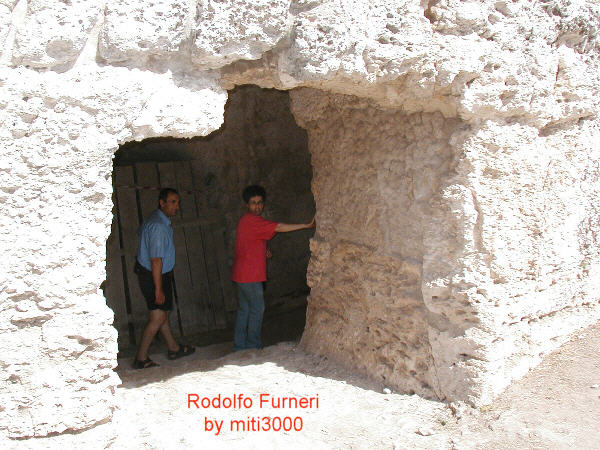
Tutti i percorsi erano stati progettati e costruiti nel tentativo ovvio di ostacolare il nemico, cercando di canalizzarne l'avanzata, spingendolo verso luoghi ristretti facili da difendere.
Attraverso questa porta raggiungiamo il recinto superiore e da lì il centro della fortezza a ridosso delle cinque torri che, seppur dirute, rimangono fedeli testimoni di un passato glorioso.
Qui non è difficile immaginare le grida e le voci che accompagnavano, inevitabilmente, gli assalti dei nemici, tesi ad occupare una fortezza che nel loro tentativo di conquistare la città, avrebbe sempre rappresentato una spina nel fianco, potendo essa contenere tremila soldati e seicento cavalieri.
Percorriamo nel recinto l'ultimo tratto che ci porta verso la sua estremità, la punta sottile del "chiodo", rivolta ad est verso Siracusa e il mare. Sembra la prua di una nave che naviga in un mare di storia. Man mano che ci si avvicina all'estremità, la vista s'allarga fino a dominare l'intera vallata che circonda la città e il suo porto che si stagliano in fondo all'orizzonte, testimoni di passate civiltà e speranze di future generazioni.
Tino Insolia
Greek colonization and foundation of Syracuse
Greek colonization, which developed between the 8th and 6th centuries BC, brought Greek civilization to a vast area of southern Italy and Sicily. Numerous and precious testimonies of this phenomenon remain, including temples, theaters, fortification walls, statues, ceramics, coins, and so on.
“The Greek word we usually translate as ‘colony’ is apoikia, meaning ‘emigration…’ each of these (“colonies”) was an independent Greek community, not a colony in the traditional sense of the word. And since the movement was a response to demographic and agricultural difficulties, the new communities themselves were agricultural settlements, not trading centers (unlike the Phoenician colonies of the west).
For the same reason, the aristocrats of the largest of the new communities, Syracuse, were called Gamoroi, “those who divide the land, the landowners” (while the enslaved natives and other land workers were called Kyllirioi). Relations between the colony and the mother city never had a commercial or otherwise imperialistic basis, precisely because the "colonies" were independent from the beginning, politically and economically, and overall they maintained close and friendly relations with the mother city for many years. (Finley, The Ancient Greeks, Einaudi, 1965).
But what drove so many thousands of people to abandon Greece, emigrate, and found new cities far from their homeland?
With the transition from monarchical to aristocratic regimes, the lands ended up in the hands of the richest, and the poor became ever poorer.
One of the main reasons for colonization was precisely to somehow dispose of the excessive number of urbanized peasants and, in any case, excess and discontented sectors of the population.
Towards the middle of the 8th century BC, this flight from Greece and the founding of Greek colonies in Sicily and southern Italy began.
The places where colonies were most often founded were those where commercial ports already existed. Often, the first colonies in turn founded other cities.
Almost always, the mother city provided the colonists with the necessary means and appointed the leader of the expedition (the ecista), which could also take place in several phases and was sometimes permitted by the native populations for some compensation, while other times conflictual relationships arose.
The second of the Greek cities in Sicily was Syracuse, founded by a group of citizens of Corinth led by the ecista Archias around 732 BC.
On the history of the founding of Syracuse, Strabo, who lived 700 years after the event, reports that “Archias, sailing from Corinth, founded Syracuse about the same time as Naxos and Megara were founded… Archias, continuing on his voyage, met some Dorians… who had separated from the colonists of Megara; he took them with him and together they founded Syracuse”.
Usually, cities were built according to an orthogonal plan, that is, with (rather narrow) streets that crossed at right angles. The center of the city was the Agora, a square where all the most important business took place.
The artists, architects, sculptors, and painters who worked in the Italiot cities usually replicated the stylistic models used in their hometowns, but they often brought interesting innovations to these models.
V. Accarpio
THE CHARACTERS:
- Moschus of Syracuse (2nd century BC), poet. He is credited with several fragments of pastoral and erotic poems inspired by Theocrite, particularly the epyllion Europa, which recounts the well-known fable of Zeus transforming into a bull for the love of the maiden of Tyre, and the idyll Eros Fugitive, which recounts Aphrodite's promise of a night of love to whoever brought her missing son back alive. Of Moschus's rhetorical interests and grammatical studies, only the title of one of his works, On Rhodian Words, has survived.
- Gelon (Gela ca. 540 - Syracuse 478 BC), tyrant of Gela (491-485 BC) and Syracuse (485-478 BC). Commander of the cavalry of Hippocrates, the previous tyrant of Gela, he succeeded him in 491 BC. In 485 BC, taking advantage of internal strife in Syracuse, he also took over this city, leaving the government of Gela to his brother Hiero I. In a short time, Gellon became very powerful and extended his dominion over much of eastern Sicily. In 481 BC, during the Second Persian War, Athens and Sparta asked him for help against the Persians; Gellon accepted, but demanded command of the army, a condition that was rejected. In 480 BC He defeated the Carthaginians, who, under the pretext of supporting the former tyrant of Himera, Terillus, in the reconquest of the city, were actually threatening the hegemony of the allied Greek cities of Syracuse and Agrigento on the island. The victory at Himera instead strengthened Gelon's influence in Sicily, who died two years later, leaving Syracuse to his brother Hiero I of Gela.
- Agathocles (? c. 360 - Syracuse 289 BC), tyrant of Syracuse (316-289 BC), probably assumed the title of king in 304 BC. He continued the Syracusan offensive strategy against the Carthaginians, by whom he was defeated at Ecnomus in 310 BC; he then carried the war to Africa, threatening Carthage itself, with whom he, however, had to negotiate peace. His influence extended throughout Sicily, with the exception of Agrigento. By his will, upon his death, the government of the city was entrusted to the people of Syracuse.
- Hiero II (Syracuse 306-215 BC), king of Syracuse (265-215 BC). Of obscure origins, later disguised by feigning an illustrious lineage from Hiero I, he was Pyrrhus' lieutenant in the wars against the Carthaginians of Sicily; he later assumed command of the Syracusan army, effectively taking over the city. An enemy of the Mamertines, the Campanian mercenaries who had occupied Messina, despite an initial failure, he defeated them at Milazzo in 265 BC, after which he was acclaimed king of Syracuse. When in 264 BC When the Romans intervened in Messina on behalf of the Mamertines (in the First Punic War), Hiero initially allied himself with the Carthaginians to counter Roman intervention, and then (263 BC) negotiated a treaty with the Romans themselves with very harsh economic conditions, which were only remitted in 248 BC. From then on, he remained loyal to Rome, especially against the Carthaginians, while maintaining good relations with other rulers, particularly the Ptolemies of Egypt. An enlightened ruler, he favored the arts and literature and established a tax system (lex hieronica) so efficient that the Romans themselves imitated him. He was succeeded by his young nephew Hieronymus.
- Theocritus (Syracuse c. 310 – c. 250 BC), poet, creator of the pastoral genre. Little biographical information is available, mostly gleaned from his works: he was born in Syracuse, where he spent his youth, and lived in this city probably until 275-274 BC, when he composed an idyll entitled The Graces in which he appealed to Hiero II to obtain his favor and protection. He then left his homeland and moved to Alexandria, where between 274 and 270 BC he wrote the Encomium to Ptolemy, a poem dedicated to the king of Egypt Ptolemy II Philadelphus, whose generosity he praised. He also came into contact with Callimachus, whose poetics he shared (as attested by the idyll The Thalysias), but without, like him, attempting to become a poet-philologist. He spent the rest of his life between Alexandria and the island of Kos, a notable cultural center and home to famous poets such as the elegiac Philetas. The year of his death remains unknown, but it is certainly dated after 260 BC.
- Hiero I (? - 466 BC), tyrant of Syracuse (478-466 BC), succeeded his brother Gelon. Hiero was known for his military valor and before ascending the throne had distinguished himself in the Battle of Himera in 480 BC. He made Syracuse the principal city of Sicily and founded the city of Etna (475 BC). His victory over the Etruscans at Cumae in 474 BC preserved the independence of the Greek colonists in Italy. In 472 BC, the Syracusan army defeated Thrasideus, king of Akragas (modern Agrigento), and Hiero became the supreme lord of Sicily. He was known for his cruelty, but also for the protection he granted to poets and philosophers.
- Archimedes (Syracuse 287-212 BC), mathematician and physicist. He was one of the greatest mathematical scholars of antiquity, interested in various fields of physics, and a brilliant inventor. He studied in Alexandria, Egypt, where he was perhaps a student of Euclid.
- Dionysius the Elder (432-367 BC), tyrant of Syracuse from 405 to 367. Of humble origins, he was a government official before seizing power illegally. In 404, he made peace with the Carthaginians, who had occupied almost all of Sicily; he then undertook a series of military campaigns in Sicily and Magna Graecia, attempting, starting in 398, to expel the Carthaginians from the island, initially achieving some success. Using mercenaries, Dionysius made Syracuse the most powerful city on the island.
- Epicharmus (c. 540 BC - c. 450 BC), Greek playwright, traditionally born in Kos, but according to other sources in Syracuse, and certainly raised in Megara, Sicily. From 484 BC, Epicharmus lived in Syracuse, where he enjoyed the patronage of Gelon and Hiero I.
Not wishing to continue this long list, I'll just add a few of the illustrious figures who have been guests in the city of Syracuse:
Simonides of Ceos - Plato - Lysias - Bacchylides - Pindar - Calamis
Those of you lucky enough to visit this city absolutely mustn't miss a stop at the legendary BRANCATO pastry shop located at Via Grottasanta, 219.
Let's start with Castello Eurialo
Built by Dionysius the Elder between 402 and 397 BC, it takes its name from the Greek Euryelos due to its shape resembling a "large-headed nail." It covers an area of 15,000 square meters and is divided into two parts: the keep with the military quarters and the enclosure.
It has three elevations: a western one that also represents the front of the castle, while the other two, southern and northern, join to form the tip of the "nail," facing east toward the sea. On the front elevation stand five square towers, probably fifteen meters high at the time of their construction. Behind them, war machines, known as ballistae, allowed the castle to hurl stones and other offensive materials at its enemies.
In front of the towers, you can still see the remains of a wedge, whose walls served as an additional defensive element, and three moats. The first, six meters long and four meters deep, is now completely filled in. The second, located eighty-six meters from the first, is fifty meters long, twenty-two meters wide, and seven meters deep. Finally, the third moat, adjacent to the towers, is eighty meters long, seventeen meters wide, and nine meters deep. It is the most important because it connects all the defensive sections.
The fortress was equipped with ingenious structures capable of ensuring tenacious resistance. Along the northern flank, in fact, one can admire an access gate, protected by funnel-shaped walls, hidden by others arranged transversally, while to the south are the remains of three pillars that supported the drawbridge.
The presence of three large cisterns and the studied defensive solutions, such as the double walls to the south, suggest the long periods of resistance that this fortress could guarantee.
The Castle's orientation, predominantly along an east-west axis, was designed so that the defenders, at least on the main front, would not have the sun in their eyes in the morning, when presumably the enemy, after a night's rest, might attempt a new assault. In the afternoon, fatigue might have discouraged the besiegers from attacking, while at night the three moats certainly served as an excellent deterrent. In the dim night light, in fact, they represented death traps.
Inside the Castle, behind the five towers, a Byzantine-era courtyard served as barracks. Thanks to an ingenious 480-meter-long system of stairs and tunnels, the troops could move quickly from one point to another according to defensive needs.
Historical Necessity
For a city like Syracuse, located on the sea, the sudden arrival of an enemy fleet could represent a very serious danger, perhaps no longer capable of being fought.
If on land, powerful walls could defend the city and enable its inhabitants to resist even for long periods, a fierce enemy that suddenly appeared in the Grand Harbour would hardly have been repelled and driven back into the open sea or destroyed on the spot.
Furthermore, the sea route could represent the last chance of escape from an enemy who had overwhelmed the last defenses by land. It was therefore essential to scan the sea horizon above all to prevent possible attacks and organize a better defense. Ortygia, the small island on which Syracuse was founded in 734 BC by Corinthian colonists, less than fifty meters above sea level, could only guarantee a view of a few nautical miles. Hence the urgent need for an observation post sufficiently high and sufficiently close to the city.
From the Marina, the current promenade in Ortygia, the gaze embraces only the broad, luminous panorama of this splendid inlet, starting from the steep coasts of the promontory, known as Capo Murro di Porco, facing Castello Maniace, the easternmost tip of the island. It was this notable narrowing at the harbor exit that, thanks to several ships linked together by powerful chains, allowed the Syracusans to block the escape route of the Athenian fleet, arrogantly anchored in those waters, and destroy it in 413 BC during the Second Peloponnesian War.
The view continues along the thin line of sandy shores, sliding between gray reed beds to the adjacent mouths of the Anapo and Ciane rivers, fringed by green tufts of umbrella-like papyrus.
Entering the quiet and safe harbor must have been a joyful and exhilarating moment for the crews, tired from days or weeks of sailing. Syracuse not only offered one of the finest natural refuges, rare indeed, along the eastern coast of Sicily; the city, capital of Magna Graecia, was, in fact, one of the most important commercial emporiums in the Mediterranean and, therefore, full of attractions of all kinds.
It should also be remembered that Syracuse was the largest Greek outpost to the west and maintained intense cultural, political, and economic relations with the motherland.
Waters safe from sudden storms, especially in winter, welcomed Greek and other vessels that came for trade.
The city, thanks to its location and the boldness of its citizens, managed to develop well, reaching its peak splendor under the reign of Dionysius the Elder, which lasted from 405 to 367 BC.
The history of the Castle is intimately intertwined with the figure of this tyrant, a hated and feared figure in history, a symbol of blind absolutism, despotism, and the cult of the individual, a forerunner of Louis XIV, the Sun King. These models, unfortunately, were copied in the twentieth century, with apocalyptic results in their brutal inhumanity. The history of Eurialo Castle, therefore, begins at the end of the fifth century with the tireless work of Dionysius, aimed at rebuilding and strengthening the city's defenses, especially in view of the inevitable clash with the Carthaginians. Indeed, they would certainly have frowned upon Syracuse's expansionist attempt, designed to recover from the deep institutional and economic decline into which the city had fallen following the wars against Athens and internal conflicts between Hermocrates and Dione, which practically escalated into civil war.
The defenses along the northern flank, in particular, had proved to be the Achilles' heel in the war against the Athenians due to their weakness. Demosthenes, the general commanding the Athenian army, had easily occupied the high hill of Epipolis twice, from which he had then descended towards the city to lay siege to it.
To the south, Syracuse was protected by nature. The Lisimelian Marshes, now reclaimed and known by the significant toponym of Pantanelli, represented a serious obstacle to the rapid movement of troops and war machines, in addition to the looming threat of malaria.
According to the historian Diodorus Siculus, Dionysius began strengthening the defenses on the north side, building a wall over five thousand meters long in just twenty days with the help of sixty thousand men, drawing the necessary materials from the generous territory of the Iblei. Behind Eurialo Castle, about three kilometers near the crossroads for Priolo and Floridia, a spectacular view almost suggests the location of the quarry from which the Syracusans likely extracted the gigantic limestone blocks needed for the great work.
A large natural amphitheater, in fact, formed by numerous steps, remnants of ancient sea cliffs, preceded by a large flat area, leads to this fascinating observation.
Imagination often fills in the gaps in history. Furthermore, the presence of several quarries nearby, which still today extract building materials from the depths of the Hyblaean Mountains, heightens the sensation and desire to imagine events that took place in very remote times. Naturally, the wall, however mighty, alone would not have been enough to stem the enemy assault if it had not been supported by forts along its length. These were presumably connected to the main fortress, Eurialo Castle.
It is beautiful to relive, through the words of Diodorus Siculus (XIV 18,2-7) the description of the construction of the northern wall, exactly 30 Attic stadia long, according to his testimonies, that is 5580 meters, which connected the Epipolis to the sea and to which the Castle would later be joined:
Having seen that during the war with Athens the city had been blocked by a wall that ran from sea to sea, he feared, in similar cases, that he would be cut off from all communication with the surrounding territory: he saw clearly that the place called Epipolae dominated the city of Syracuse. He turned to his architects, and on their advice he decided to fortify Epipolae with a wall, which still stands today in the area around the Hexapylon (the "six gates"). This place, facing north, entirely rocky and sheer, is inaccessible from the outside. Wishing to have the walls built quickly, he summoned farmers from the countryside, from whom he selected the best men, 60,000 in number, and distributed them along the section of the wall to be built. For each stadium he appointed an architect and for each stone a master mason, to each of whom he assigned 200 workers. 6,000 yokes of oxen were employed at the designated location.
The activity of so many men, zealously applying themselves to their task, presented a remarkable spectacle. And Dionysius, to stimulate the enthusiasm of this multitude, promised great rewards to those who finished first, especially to the architects, then also to the master masons, and finally to the laborers. He himself, with his friends, watched the work for whole days, inspecting every place and having those who were tired replaced. In short, renouncing the dignity of his office, he reduced himself to a private rank, and subjecting himself to the heaviest labor, endured the same toil as the others: consequently, great emulation arose, and some even added part of the night to their working day. Such was the enthusiasm of that mass of laborers. Consequently, the wall was completed, beyond all hope, in twenty days: it was thirty stadia long, and of proportionate height, and so strong as to be considered impregnable. There were tall towers at frequent intervals, built of blocks 4 feet long, carefully joined.
A Visit to the Castle
Even today, it is a journey back in time, capable of offering intense emotions. Built in a relatively short time, given the vastness of the work, from 402 to 397 BC, right on the Epipoli (from the Greek "above the city") west of Syracuse, just eight kilometers from Ortygia, it is the greatest feat of military engineering in Magna Graecia, the crowning achievement of the defensive works commissioned by Dionysius, who thus succeeded in joining the northern walls with those to the west of the city, for a total length of approximately thirty-two kilometers.
Its construction, as evidenced by the numerous remains of nearby dwellings, allowed for the development of a large neighborhood, Epipoli, which, together with the other four neighborhoods of Tyche, Neapolis, Ortigia, and Acradina, represented the entire urban area, large and well-structured. According to some estimates, the total population at the time was over three hundred thousand.
As in our own Middle Ages, a dense population gathered near the castle. In times when victorious enemies were not so subtle and, once conquered, indulged in pillage and massacres, the people felt protected in their lives, in their trade, and in their work by the reassuring presence of weapons. Not to mention that the fortress, in times of danger, could also accommodate them.
Coming from Ortigia and climbing towards Epipoli, you have the pleasant sensation of a view that expands, overlooking an ever-expanding territory and an ever-distant horizon.
After passing the site of the ancient Neapolis district, above the Greek Theater, and a now-disused Air Force post, the road leads us to one of the city's access gates, along the western walls, very close to Eurialo Castle, whose southern perimeter we see towering a little higher.
The remains of the old walls next to the gate already give us an idea of the value of these walls. Olive, almond, and carob trees, as well as mastic, holm oak, and euphorbia, adorn and shade the steep hillside that rises to the castle's southern flank.
A final kilometer, a few more short hairpin bends, and finally you enter the narrow, difficult parking lot. The entrance to the site, which is free, is shaded by a group of pine trees on the right, offering a small respite in the early afternoon heat. The caretakers, seated and bored, seem to have been part of the landscape for centuries, discreetly ignore you.
After passing this small green oasis, we finally come face to face with this marvelous scene. If the "words" in a famous book by Carlo Levi "are stones," to paraphrase that title, in this place we can say that the stones have once again become words, messages delivered to history by the multitude of men who lived and died here.
The five towers rise as if to prop up a sky filled with a luminosity that pervades you to the core and captivates you, making you feel like a lizard advancing with measured steps, basking on the sun-warmed stones. Dazzling white, it looms before you like a battleship poised to fire, nestled on the ridge rising from the sea.
From this vantage point, you can glimpse the lower Anapo Valley to the right, while to the left, the industrial ruins of Priolo and Augusta mar a marvelous landscape, consisting of the coastline that curves toward the Gulf of Catania, with Mount Etna looming majestically over the city. Further away, the high coast of Taormina, and on windy days, even the thin strip of Calabria is visible.
It's lovely to stop and admire the battlements and moats in front. The entire visit to the Castle, already tiring due to the constant ups and downs, should be done slowly, lingering at the numerous points where the interplay of forms and the vast, expansive spaces of sky and earth offer sensations of profound well-being.
Far from noise, in the silence of these walls, a profound sense of well-being pervades you. You hear only the breeze rising from the sea, swaying the tender stems of the already dry grass. The bare and grim thistles resemble soldiers encased in their bronze armor, their sculptural, sharp stems and thorns.
We enter the castle through a gate on the north side at the level of the third and final moat, the largest, and we immediately feel immersed in an easily imaginable reality.
A corridor, parallel to the moat and carved into the living rock to the left, features multiple access windows with stone gables along its entire length. These windows, shading the interior, allowed the hidden defender to strike and skewer any enemy who, dazzled by the sun, had imprudently stepped forward.
At one end of the corridor on the left, the beginning of a dark tunnel sparks our imagination with possible secret passages. We continue along it until, still on the left, another tunnel, this time ascending, draws us with its dim sunlight down to the end.
In the soft but solid limestone, winding paths allowed for traps and ambushes against unwary enemies. This tunnel, in fact, leads us to a narrow plateau, enclosed between the two rows of walls on the southern side of the fortress.
Enemy soldiers who had arrived here in the open, driven by the impetus, would have found themselves surrounded by battle-hardened and determined defenders. Taking advantage of a prominence in the rock face, a hidden door at the end allowed other soldiers to complete the encirclement.
All the routes were designed and built in the obvious attempt to hinder the enemy, trying to channel their advance, pushing them towards narrow spaces that were easy to defend.
Through this gate we reach the upper enclosure and from there the center of the fortress, close to the five towers which, though in ruins, remain faithful witnesses to a glorious past.
Here it is not difficult to imagine the shouts and voices that inevitably accompanied the enemy's assaults, intent on occupying a fortress that, in their attempt to conquer the city, would always be a thorn in their side, capable of holding three thousand soldiers and six hundred cavalry.
We walk the last stretch of the enclosure that leads us to its end, the thin tip of the "nail," facing east toward Syracuse and the sea. It resembles the prow of a ship sailing on a sea of history. As you approach the edge, the view expands to dominate the entire valley surrounding the city and its port, which stand out on the horizon, witnesses of past civilizations and hopes of future generations.
Tino Insolia