Siracusa, teatro greco, Orecchio di Dionisio e...
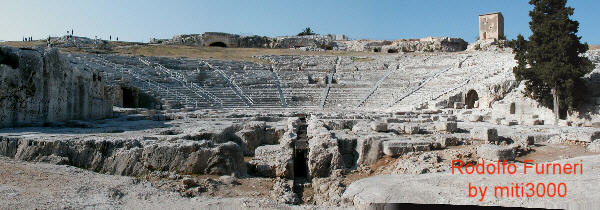
Dopo la visita al Teatro Greco, adagiato sui fianchi del colle Temenite di Siracusa, scendiamo dalla sua sommità, ancora ebbri per la visione di mirabile bellezza di cui abbiamo goduto. Brevi e sinuosi tornanti ci sprofondano in un giardino ricco di variopinti oleandri, immersi tra i profumi di alcune piante, tipiche della flora mediterranea. I rami degli oleandri tra l'altro, disposti da ambo i lati come una guardia d'onore, sfiorandosi in alto sembrano descrivere una piccola galleria vegetale che ci avvolge con il suo respiro caldo e voluttuoso. Dopo poche decine di metri giungiamo ad una piccola radura.
L'impatto visivo suscita immediatamente una piena e profonda suggestione.
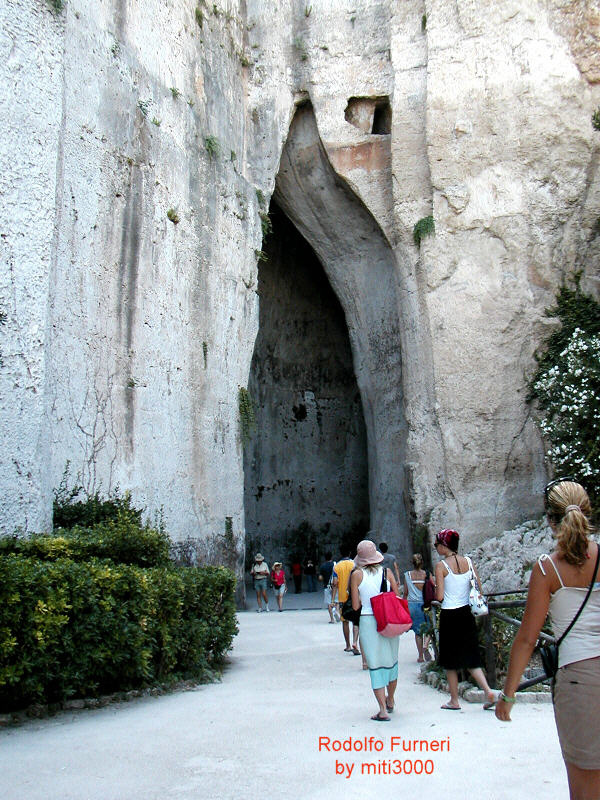
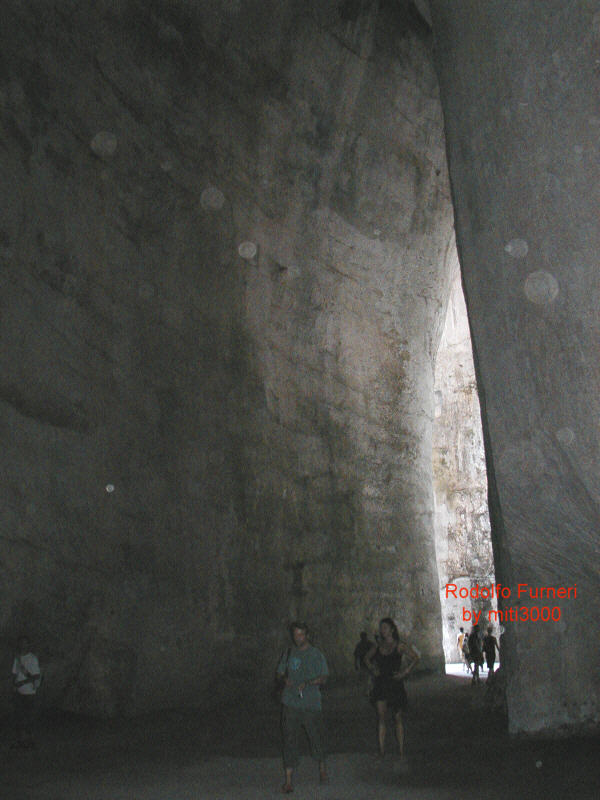
Ventitre metri di altezza per sessantacinque di lunghezza ed una larghezza che va restringendosi gradatamente dagli undici metri iniziali ai sei finali incidono profondamente la parete a strapiombo che si para di fronte ai nostri occhi.
Il nostro sguardo s'innalza per potere ammirare per intero questa fantastica visione, che assume le sembianze di una ferita nel tessuto verticale della tenera roccia sedimentaria.
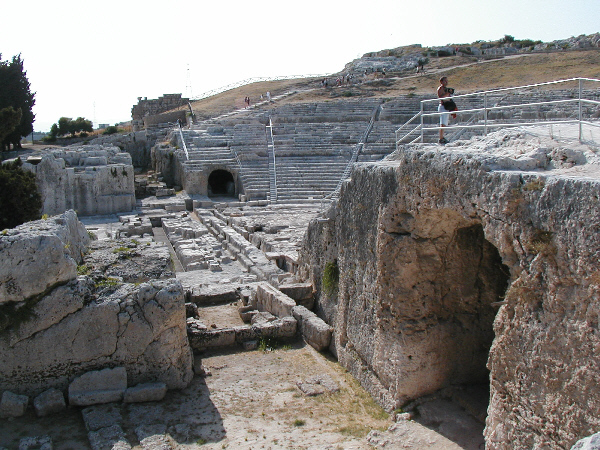
Di colpo si è come proiettati indietro nel tempo con la sensazione precisa, se non fosse per il continuo via vai dei turisti, di vedere apparire da un momento all'altro sulla soglia il gigante Polifemo alle prese con l'astuto Ulisse.
Tutto si presta a questa omerica illusione, soprattutto il breve respiro del luogo, chiuso da alte pareti che lo rendono cristallizzato nel tempo e che hanno impedito la sua profanazione da parte dei profondi cambiamenti che hanno interessato, invece, le zone prospicienti il sito archeologico.
Nella sua arcaica e naturale bellezza questo luogo risplende, perciò, di un forte valore evocativo.
La nostra stessa ammirazione dovette colpire Caravaggio che nel 1608, nel corso della sua breve vita e durante il suo tormentato vagabondare, si trovò a visitare questo luogo, definendolo per l'evidente somiglianza antropomorfica l' "Orecchio di Dionisio", dando fiato così alla leggenda del famoso tiranno.
Si tratta, infatti, di una fenditura apparentemente naturale, tanto sembra armoniosamente inserita nel contesto ambientale, adornata all'esterno da piante di capperi e capelveneri. Le pareti che già si intravedono dalla radura antistante sono lisce, come levigate dalle mani di un gigante. Esse si snodano sempre lisce e sinuose, dando origine ad un movimento plastico di notevole e piacevole effetto estetico, conferendo a questo luogo fascino e mistero.
Questo "tempio" dove la Storia sembra richiudersi per celebrare i suoi miti e le sue leggende, può essere considerato a pieno titolo un monumento perché (e sveliamo un piccolo segreto) esso rappresenta in effetti l'aspetto finale di una cava dalla quale i Siracusani, in tempi successivi, hanno tratto il materiale servito loro per la costruzione di templi ed edifici pubblici e privati, la maggior parte dei quali splendono ancora di storia nei numerosi angoli della città.
Man mano che il lavoro di scavo ha proceduto e i materiali ottenuti sono stati portati via il piano inferiore della cava si è sempre di più abbassato, fino al livello attuale.
Chiunque lo ammira non può che condividere la definizione del pittore lombardo. L'aspetto esterno è di un enorme padiglione auricolare e il percorso interno assomiglia, per analogia, al tratto tortuoso che conduce al nostro timpano.
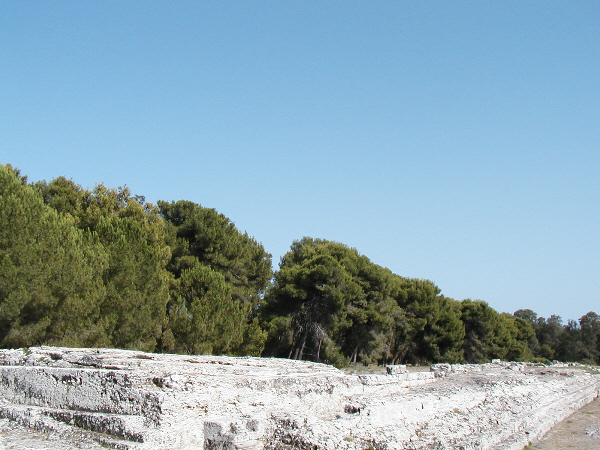
Ciò che ha sempre stupito e affascinato, oltre la forma, è stato l'effetto acustico che si produce all'interno della grotta, nata per azione dell'Uomo. Grazie alla disposizione curvilinea delle sue pareti (che si fondono alla sommità), all'altezza, alla profondità e alla natura delle rocce si ottiene un effetto acustico di notevole suggestione che amplifica ogni piccolo rumore. Perfino un brusio, un piccolo mormorio diventa chiaramente udibile a distanza.
Chi scrive, ricorda da adolescente il fragore simile ad un colpo di cannone, provocato dal battere del tocco di bronzo sulla base fissa, anch'essa dello stesso materiale, posti sul portone di legno massiccio che negli anni Cinquanta e nei primi anni Sessanta limitava l'accesso al sito.
L'intero complesso archeologico, a dir la verità, era un luogo molto frequentato da studenti e non solo per motivi culturali. Alunni di diverse scuole e classi si ritrovavano, spesso, qui per bigiare in un luogo sicuro, al riparo da sguardi di genitori e insegnanti o meglio da "minacciate" interrogazioni o da compiti di greco e di matematica che non si sarebbe saputo come svolgere.
Secondo la leggenda il tiranno Dionisio faceva rinchiudere qui i prigionieri politici. Approfittando della particolare acustica s'era fatto costruire una casetta il cui pavimento era in comunicazione con la volta superiore della grotta. Ciò per ascoltare i loro discorsi e sventare eventuali complotti.
In effetti, una casetta esiste alla sommità del Teatro Greco, che sembra quasi evocare la leggenda, ma essa è solo l'ultima testimonianza di una serie di mulini che nei secoli passati utilizzavano la forza motrice dell'acqua del canale Galermi, sorgente a pochi passi da essi. Ricordiamo che essa alimenta dal V secolo a.C. fino ad oggi l'acquedotto di Siracusa.
Abbiamo detto in apertura che Michelangelo Merisi, detto il Caravaggio, con la sua fantasia lo definì l'Orecchio di Dionisio, avvalorando l'immagine di un tiranno crudele e molto sospettoso.
Parlare di questo monumento ci da quindi l'opportunità di tratteggiare la figura di Dionisio I, il Grande, tiranno di Siracusa a cavallo del V e del IV sec a.C. e più in generale su quest'ultimo termine, usato quasi sempre in maniera dispregiativa, come di persona caratterizzata da una profonda visione antidemocratica, uccisore delle libertà e della partecipazione popolare al governo della città.
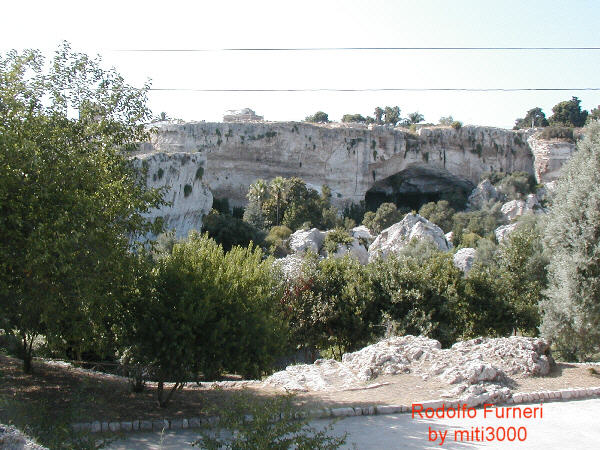
Indubbiamente, tutti coloro che operarono per imporre la loro signoria erano mossi da una grande sete di potere. Molto ricchi e in grado di condizionare gli umori della plebe, avvalendosi di alleanze con altri potenti vicini, essi in genere comparivano quando la situazione democratica della città si deteriorava.
Molti, come purtroppo è avvenuto tante volte in seguito, auspicavano a questo punto la comparsa di un uomo forte che mettesse fine a disordini e degenerazioni, oltre che a rivendicazioni in ordine alla distribuzione delle terre e alla ricchezza più in generale.
Spesso i disordini erano provocati dagli stessi aspiranti tiranni.
Su Dionisio molto è stato scritto e io non pretendo certamente di esaurire un argomento così vasto, descrivendo in poche righe una figura così importante e complessa della storia siracusana. Egli compare al seguito di Ermocrate, quando questi aveva cercato nel 408 a.C. di penetrare con la forza in Siracusa, in seguito a rivalità con Diocle.
Ermocrate venne però ucciso e i suoi compagni banditi, tranne Dionisio ritenuto morto. Tre anni dopo le alterne vicende della guerra contro Cartagine, sprofondano Siracusa in una situazione di grave pericolo. Dionisio assume il potere grazie a dei mercenari e riorganizza la struttura politica dello Stato, favorendo all'inizio gli amici che lo avevano sostenuto.
Cinge di opere difensive la città, costruendo alte mura attorno ad Ortigia, l'isola che diventò la sua residenza fortificata. Appena pronto si mosse per riaffermare il dominio siracusano lungo la valle dell'Anapo, attaccando e distruggendo Erbesso (presso l'attuale Buscemi), spina nel fianco degli insediamenti greci, specialmente della fortezza di Acre (Palazzolo Acreide).
Con la politica del bastone e della carota tranquillizzò i suoi vicini, alleandosi nel frattempo con Sparta. Nell'anno 401 a.C. presso un santuario posto alle pendici sud-occidentali dell'Etna, fondò un insediamento militare che chiamò Adrano (Adernò).
Prevedendo la sicura reazione cartaginese con grande celerità si dedicò alla costruzione del Castello Eurialo, cioè a forma di chiodo, imprendibile fortificazione posta alla sommità dell'Epipole, un colle che, distante pochi chilometri da Siracusa, domina per lunghi tratti le coste e la bassa valle dell'Anapo.
Ancora oggi esistente, esso rappresenta una delle opere più ingegnose di arte militare, geniale esempio di difesa delle città greche.
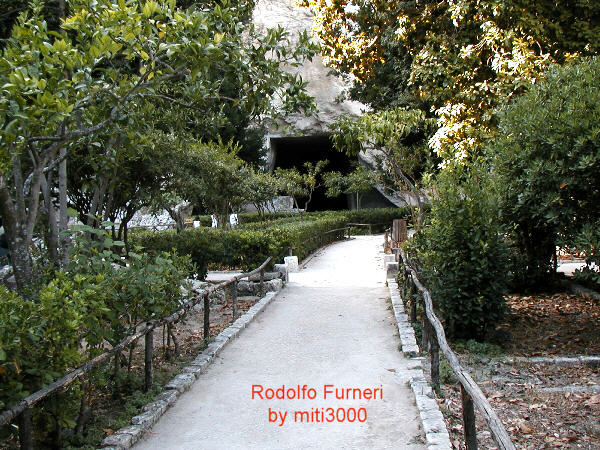
Resa sicura la città, si dedicò ad un nuovo programma espansionistico. Grazie alle invenzioni dei suoi consiglieri militari, in particolare della catapulta, in grado di scagliare sassi a notevole distanza, e la costruzione delle quinqueremi, vere e proprie corazzate più sicure e veloci delle triremi, si sentì pronto per ridare a Siracusa prestigio, potenza e splendore. Dopo essersi assicurato alleanze o neutralità da parte delle principali città siceliote, dichiarò guerra a Cartagine nell'anno 397, riconquistando a Siracusa tutto il territorio precedentemente perduto.
Non pago di questo risultato continuò nel suo progetto imperialista e nel periodo immediatamente successivo conquistò parecchi punti strategici del Tirreno (tra cui l'isola d'Ischia) e dell'Adriatico (debellando i pirati), rendendoli mari sicuri e sotto il dominio delle flotte siracusane.
La vita di Dionisio andrebbe raccontata con maggiore approfondimento, perché ricca ancora di numerosi avvenimenti. Morì a 63 anni e la sua tirannia durata per ben 38 (405-367 a.C.) rappresenta il culmine della potenza siracusana, un periodo importante anche per la storia delle altre colonie greche in Italia. Siracusa, grazie a lui, divenne la più potente città della Magna Grecia.
Prototipo del tiranno crudele, la sua figura è stata nei secoli molto maltrattata: da Timeo a Cicerone, fino a Dante è un susseguirsi di accuse. Non ammetteva nessuno alla sua presenza che non fosse stato prima perquisito dalle sue guardie. A questa regola non sfuggivano nemmeno figli e nipoti e persino le mogli. Si faceva radere solo dalle figlie.
Non esitò a ordinare la morte di molti nemici, anche suoi concittadini, giustificando questi atti come doverosa sottomissione alla ragione di Stato.
So di essere sembrato troppo lungo a descrivere la sua figura ma sono sicuro che la visita dell' "Orecchio di Dionisio" evocherà ai più sensibili i palpiti di un'epoca irripetibile, per certi versi lontana dalla nostra sensibilità moderna ma, sicuramente, carica di fascino e di profonde radici culturali con le civiltà del passato.
Dionisio non riuscì a sconfiggere definitivamente Cartagine ma ne rallentò l'espansione, consegnando idealmente a Roma il compito di annientarla. Nel III sec a.C., infatti, Roma riprese con vigore la lotta contro i Punici, fino all'epilogo finale che tanto sarebbe piaciuto a Dionisio: Cartago delenda est e Cartagine delenda fu.
Tino Insolia
Il teatro greco di Siracusa
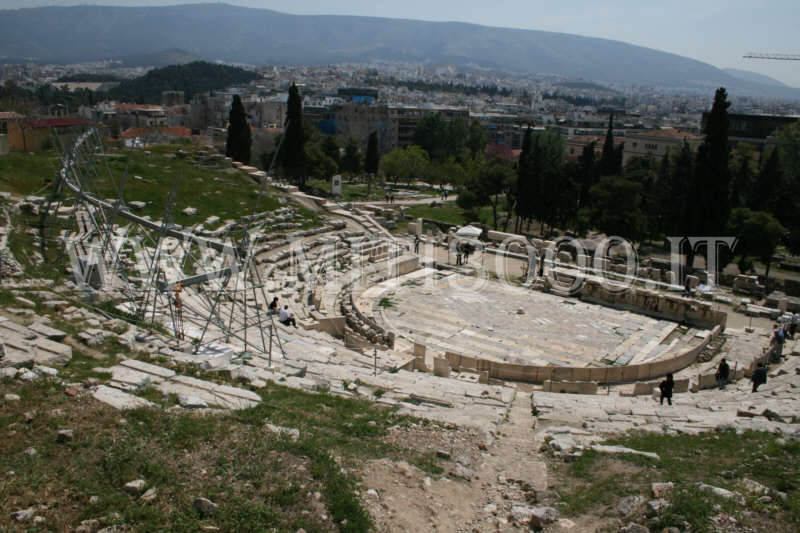
Sulla sommità del Teatro, secondo Cicerone, c’erano i santuari di Demetra e Kore e delle Muse. Eschilo vi rappresentò Le Etnee ed I Persiani. Ha un diametro di circa 140 metri e 67 ordini di gradini divisi in 9 settori da 8 scalette e, orizzontalmente da due ambulacri. Fu opera dell’architetto Damocopos, detto Myrilla. La parte più alta della cavea anzicché essere scavata nella roccia fu costruita con blocchi di pietra che, in seguito (XVI secolo) furono portati via per essere utilizzati in altre costruzioni. Il Teatro disponeva di alcuni tipi di macchine di scena.
I teatri greci più antichi che presentano una struttura simile a quello di Siracusa furono, in Grecia, quello di Eleusi e quello di Torico, entrambi del VII secolo a. C. In seguito si svilupparono forme più evolute: quale il teatro di Dioniso di Atene.
Le Latomie
A Siracusa esistono diverse cave di pietra calcarea che si cominciarono a scavare, probabilmente, poco dopo la fondazione greca della città e quindi dal 732 circa a. C. in poi. La parola latomia deriva da due parole greche:
λᾶας - las= pietra e τέμνειν - tèmnein= tagliare.
Le latomie di Siracusa si trovano tra il Teatro greco e la Latomia dei Cappuccini. I blocchi di pietra che furono tratte da esse, per circa cinque milioni di metri cubi, vennero impiegati nella costruzione di templi, di opere di fortificazione e di edifici di uso civile. Dalla lettura di Tucidide apprendiamo che queste cave furono usate anche come carceri, infatti vi furono tenuti, in condizioni terribili, gli Ateniesi catturati nel 413 a. C., durante la guerra fra Atene e Siracusa. Tucidide racconta così le sofferenze di quei prigionieri ateniesi:
“Nelle cave di pietra i Siracusani nei primi tempi trattarono duramente i prigionieri. Essendo all’aperto, in molti tra le pareti ripide di un luogo ristretto, in principio li tormentava ancora l’afa e il sole; e viceversa, sopraggiungendo le notti fredde di autunno, questo sbalzo li disponeva a malattie. Per mancanza di spazio soddisfacevano i loro bisogni nel medesimo posto; e inoltre, ammucchiandosi lì stesso l’uno sull’altro i cadaveri di chi moriva per le ferite e per il cambiamento di stagione o cause simili, ne derivava un fetore insopportabile. S’aggiunga la sofferenza della fame e della sete, poiché a ciascuno di loro davano per otto mesi una cotila di acqua (=1/4 di litro ) e due cotile di grano.
Non fu insomma risparmiato loro nessun malanno che, una volta caduti in simil luogo, potesse affliggerli. Poi, tranne le truppe ateniesi, siceliote o italiote, tutti gli altri furono venduti.
Non è possibile dare con esattezza il numero complessivo dei prigionieri, ma non furono meno di settemila.
Risultò, questa, l’impresa militare ellenica più imponente di questa guerra e, a me sembra, anche di tutte le guerre elleniche della tradizione: la più gloriosa per i vincitori, la più fatale per i vinti.
Schiaccianti sconfitte in tutti i campi, terribili sofferenze di ogni genere: fu proprio quel che si dice una distruzione completa, che inghiottì flotta, esercito e ogni cosa; e pochi di molti rimpatriarono.
Tale fu la spedizione di Sicilia.” (da: Tucidide, La guerra del Peloponneso, trad. di P. Sgroi, Milano, Ispi)
La Latomia del Paradiso, a fianco del Teatro greco, comprende: l’Orecchio di Dionisio, la Grotta dei Cordari, la Grotta del Salnitro, la Latomia della Intagliatella e quella di Santa Venera. Non molto distanti si incontrano la Latomia Broggi e quella del Casale. Infine, molto vicino al mare, la Latomia dei Cappuccini.
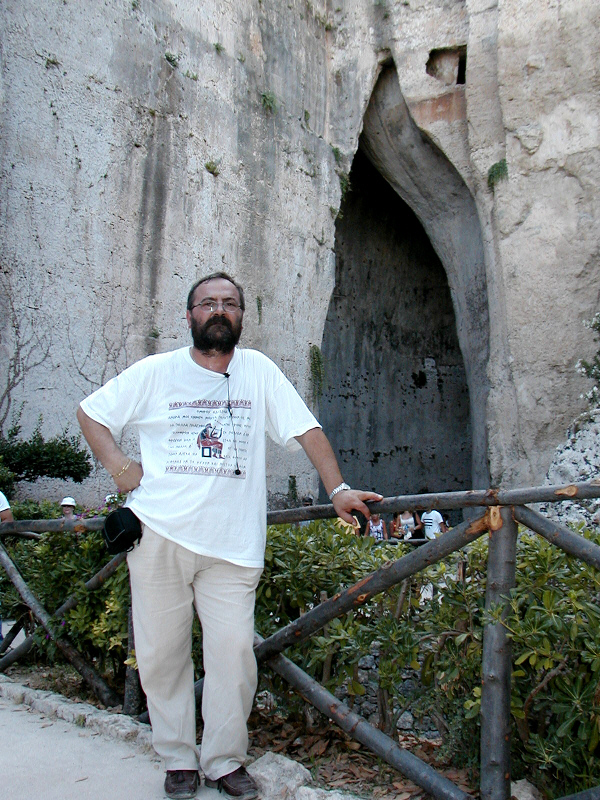
L’“Orecchio di Dionisio” è un’ampia grotta artificiale di grandi dimensioni, profonda più di 60 metri, alta più di 20 e larga fino a circa 10 metri. Ha una sezione verticale di forma quasi triangolare ed una pianta che in qualche modo ricorda la chiocciola dell’orecchio umano. Nel punto più interno e più alto presenta un foro attraverso il quale, in virtù della particolarissima acustica capace quasi di amplificare i suoni, si tramanda che Dionisio origliasse per ascoltare quanto si dicessero i prigionieri che egli vi teneva rinchiusi. Sulla scorta di questa tradizione, sembra che il Caravaggio (che visitò Siracusa nel 1608) abbia assegnato questo nome alla grotta.
La Grotta dei Cordari è una grotta grandissima che si apre a pochi metri più a destra dall’entrata dell’Orecchio di Dionisio. E’ così denominata perché in essa, per secoli e fino a pochi decenni fa, questi artigiani vi hanno svolto il loro lavoro. Essa presenta un aspetto scenografico veramente suggestivo per la varietà di superfici e di spazi che nelle tre dimensioni dell’altezza, della profondità e della larghezza permettono alla luce di produrre degli effetti sorprendenti, soprattutto quando sul piano di calpestio si sia accumulata dell’acqua.
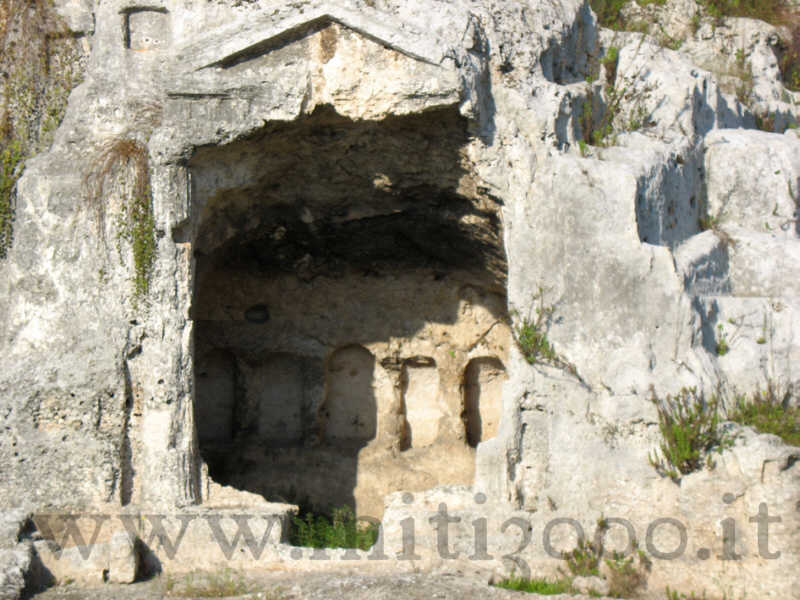
Seguono la Grotta del Salnitro sul cui ingresso è precipitato un enorme pezzo di roccia staccatosi dal fronte della volta della grotta stessa e la Latomia dell’intagliatella che presenta un pilastro roccioso di notevoli dimensioni; infine, ancora più ad est, troviamo la Latomia di Santa Venera, con le sue pareti interne ricche di nicchie votive. Queste ultime tre latomie, come anche le Latomie Broggi e del Casale, non sono al momento visitabili. Quasi al limite orientale del Parco archeologico si trova la cosiddetta Tomba di Archimede che sarebbe stata invece scavata in epoca romana per custodire nelle sue nicchie delle urne cinerarie.
La Latomia dei Cappuccini, chiamata così perché circonda la chiesa di questo Ordine religioso, è veramente molto estesa e caratterizzata da pareti altissime e di grande effetto scenografico. Anch’essa è attualmente chiusa al pubblico.
Quasi tutte le latomie, almeno quelle di proprietà del demanio pubblico, sono state o sono sottoposte a restauro a causa dei danni provocati dal tempo, da fattori meteorologici e persino da interventi sconsiderati degli uomini sul loro stesso territorio. Noi riteniamo non solo opportuno, ma anche doveroso che queste testimonianze materiali della storia della nostra Città siano restituite al più presto a noi cittadini ed ai turisti che desiderano visitarle.
V. Accarpio
Syracuse, Greek Theater, Ear of Dionysius and...
After visiting the Greek Theater, nestled on the slopes of Syracuse's Temenite Hill, we descend from its summit, still intoxicated by the vision of admirable beauty we have enjoyed. Short, winding hairpin bends lead us into a garden filled with colorful oleanders, immersed in the scents of several plants typical of Mediterranean flora. The oleander branches, arranged on either side like a guard of honor, touch each other at the top, seeming to create a small green tunnel that envelops us with its warm, voluptuous breath. After a few dozen meters, we reach a small clearing. The visual impact immediately evokes a profound and profound impression.
Twenty-three meters high, sixty-five meters long, and a width that gradually narrows from the initial eleven meters to the final six, deeply carve the sheer wall before our eyes.
Our gaze rises to fully admire this fantastic sight, which resembles a wound in the vertical fabric of the soft sedimentary rock.
Suddenly, one is projected back in time with the distinct sensation, were it not for the constant coming and going of tourists, of seeing the giant Polyphemus appear at any moment on the threshold, wrestling with the cunning Ulysses.
Everything lends itself to this Homeric illusion, especially the brief breath of the place, enclosed by high walls that make it crystallized in time and that have prevented its desecration by the profound changes that have instead affected the areas overlooking the archaeological site.
In its archaic and natural beauty, this place shines with a strong evocative value.
Our same admiration must have struck Caravaggio, who in 1608, during his short life and his tormented wanderings, happened to visit this place, calling it the "Ear of Dionysius" due to its evident anthropomorphic resemblance, thus giving rise to the legend of the famous tyrant.
It is, in fact, a seemingly natural fissure, so harmoniously integrated into the surrounding environment it seems, adorned on the outside with caper and maidenhair ferns. The walls, which can already be glimpsed from the clearing in front, are smooth, as if polished by the hands of a giant. They unfold smoothly and sinuously, creating a sculptural movement with a remarkable and pleasing aesthetic effect, lending this place charm and mystery.
This "temple," where history seems to close in to celebrate its myths and legends, can be considered a monument in its own right because (and we'll reveal a little secret) it actually represents the final aspect of a quarry from which the Syracusans, in later times, extracted the material they needed for the construction of temples and public and private buildings, most of which still shine with history in many corners of the city.
As the excavation work progressed and the resulting materials were removed, the lower level of the quarry gradually sank, down to its current level.
Anyone who admires it cannot help but agree with the Lombard painter's definition. The external appearance is that of an enormous auricle, and the internal path resembles, by analogy, the winding path that leads to our tympanum.
What has always amazed and fascinated, beyond the shape, is the acoustic effect produced inside the cave, created by human action. Thanks to the curved arrangement of its walls (which merge at the top), the height, depth, and the nature of the rocks, a remarkable acoustic effect is achieved that amplifies every small sound. Even a whisper, a small murmur, becomes clearly audible from a distance.
The writer, as a teenager, remembers the roar, similar to a cannon shot, caused by the striking of the bronze tongs on the fixed base, also of the same material, placed on the solid wooden gate that limited access to the site in the 1950s and early 1960s.
The entire archaeological complex, in truth, was a popular place for students, and not just for cultural reasons. Students from various schools and classes often gathered here to skip school in a safe place, away from the prying eyes of parents and teachers, or better yet, from "threatening" oral exams or Greek and math homework they wouldn't have known how to do.
According to legend, the tyrant Dionysius locked up political prisoners here. Taking advantage of the unique acoustics, he had a small house built whose floor connected to the upper vault of the cave. This was to listen to their conversations and foil any possible plots.
Indeed, a small house exists at the top of the Greek Theater, which almost seems to evoke the legend, but it is only the last vestige of a series of mills that in past centuries used the water from the Galermi canal, a source just steps away. It is worth remembering that this canal has powered the Syracuse aqueduct since the 5th century BC.
We mentioned at the beginning that Michelangelo Merisi, known as Caravaggio, in his imagination called it the Ear of Dionysius, confirming the image of a cruel and highly suspicious tyrant.
Discussing this monument therefore gives us the opportunity to outline the figure of Dionysius I, the Great, tyrant of Syracuse between the 5th and 4th centuries BC, and more generally the latter term, almost always used in a derogatory manner, as a person characterized by a profoundly anti-democratic vision, a killer of freedom and popular participation in the city's government.
Undoubtedly, all those who worked to impose their rule were driven by a great thirst for power. Very wealthy and able to influence the moods of the plebs, making use of alliances with other powerful neighbors, they generally appeared when the democratic situation in the city deteriorated.
Many, as unfortunately happened many times later, hoped at this point for the appearance of a strongman who would put an end to the unrest and degeneration, as well as to the claims regarding the distribution of land and wealth more generally.
The unrest was often provoked by the aspiring tyrants themselves.
Much has been written about Dionysius, and I certainly do not pretend to exhaust such a vast topic by describing in a few lines such an important and complex figure in Syracusan history. He appears in the retinue of Hermocrates, when the latter had sought to conquer Syracusan territory in 408 BC. to force his way into Syracuse, following rivalry with Diocles.
Hermocrates was killed, however, and his companions were banished, except for Dionysius, who was presumed dead. Three years later, the turbulent events of the war against Carthage plunged Syracuse into grave danger. Dionysius took power thanks to mercenaries and reorganized the political structure of the state, initially favoring the friends who had supported him.
He surrounded the city with defensive works, building high walls around Ortygia, the island that became his fortified residence. As soon as he was ready, he moved to reassert Syracusan dominance along the Anapo Valley, attacking and destroying Erbesso (near present-day Buscemi), a thorn in the side of the Greek settlements, especially the fortress of Acre (Palazzolo Acreide).
With a carrot-and-stick policy, he reassured his neighbors, while simultaneously allying himself with Sparta. In 401 BC, near a sanctuary on the southwestern slopes of Etna, he founded a military settlement that he called Adrano (Adernò).
Anticipating a certain Carthaginian reaction, he promptly devoted himself to the construction of the Euryalus Castle, shaped like a nail, an impregnable fortification located atop Epipole, a hill just a few kilometers from Syracuse that dominates long stretches of the coast and the lower Anapo Valley.
Still standing today, it represents one of the most ingenious works of military art, a brilliant example of the defense of Greek cities.
With the city secured, he embarked on a new expansionist program. Thanks to the inventions of his military advisors, particularly the catapult, capable of hurling stones a considerable distance, and the construction of quinqueremes, true battleships safer and faster than triremes, he felt ready to restore Syracuse's prestige, power, and splendor. After securing alliances or neutrality from the major Sicilian cities, he declared war on Carthage in 397, reconquering all the territory previously lost to Syracuse.
Not satisfied with this result, he continued his imperialist project and in the immediate aftermath conquered several strategic points in the Tyrrhenian Sea (including the island of Ischia) and the Adriatic (defeating pirates), making them safe seas and under the dominion of the Syracusan fleets.
The life of Dionysius deserves to be told in greater depth, as it is still rich in numerous events. He died at the age of 63, and his tyranny, which lasted for 38 years (405-367 BC), represents the height of Syracusan power, an important period also for the history of the other Greek colonies in Italy. Thanks to him, Syracuse became the most powerful city in Magna Graecia.
The prototype of the cruel tyrant, his figure has been much mistreated over the centuries: from Timaeus to Cicero, up to Dante, there is a succession of accusations. He never admitted anyone into his presence without first being searched by his guards. This rule did not even apply to his children, grandchildren, or even his wives. He only allowed his daughters to shave.
He did not hesitate to order the death of many enemies, even his own citizens, justifying these acts as dutiful submission to reasons of state.
I know I have seemed too long to describe him, but I am sure that a visit to the "Ear of Dionysius" will evoke for those most sensitive the thrill of an unrepeatable era, in some ways distant from our modern sensibilities but, undoubtedly, full of charm and deep cultural roots with the civilizations of the past.
Dionysius did not succeed in definitively defeating Carthage, but he slowed its expansion, ideally handing over to Rome the task of annihilating it. In the 3rd century BC, Rome vigorously resumed the fight against the Carthaginians, until the final epilogue that Dionysius would have so loved: Carthage is destroyed and Carthage was destroyed.
Tino Insolia
The Greek Theater of Syracuse
According to Cicero, at the top of the Theater were the sanctuaries of Demeter, Kore, and the Muses. Aeschylus performed The Etnaeans and The Persians there. It has a diameter of approximately 140 meters and 67 tiers of steps divided into 9 sectors by 8 stairways and, horizontally, by two ambulatories. It was designed by the architect Damocopos, known as Myrilla. The highest part of the cavea, rather than being carved into the rock, was built with stone blocks that were later (16th century) transported for use in other buildings. The Theater also had some types of stage machinery.
The oldest Greek theaters with a structure similar to the one in Syracuse were those of Eleusis and Thoricum, both from the 7th century BC. C. Later, more advanced forms developed: such as the theater of Dionysus of Athens.
The Latomie
Syracuse has several limestone quarries, probably begun to be dug shortly after the Greek founding of the city, starting around 732 BC. The word latomia derives from two Greek words:
las = stone and tèmnein = to cut.
The latomie of Syracuse are located between the Greek Theater and the Latomia dei Cappuccini. The stone blocks extracted from them, approximately five million cubic meters, were used in the construction of temples, fortifications, and civil buildings. From Thucydides, we learn that these quarries were also used as prisons; in fact, the Athenians captured in 413 BC, during the war between Athens and Syracuse, were held there in terrible conditions. Thucydides recounts the suffering of those Athenian prisoners thus:
“In the stone quarries, the Syracusans initially treated the prisoners harshly. Being out in the open, many of them between the steep walls of a confined space, they were initially still tormented by the heat and the sun; and conversely, with the arrival of the cold autumn nights, this change in temperature predisposed them to illness. For lack of space, they satisfied their needs in the same place; and furthermore, by piling up the corpses of those who died from wounds or the change of season or similar causes, an unbearable stench arose. Added to this was the suffering of hunger and thirst, since each of them was given a cotyle of water (= 1/4 liter) and two cotyles of grain for eight months.
In short, they were spared no evil that, once they had fallen into such a place, could afflict them. Then, except for the Athenian, Sicilian, or Italiot troops, all the others were sold.
It is not possible to give an exact total number of prisoners, but they were not less than seven thousand.
This proved to be the most impressive Hellenic military enterprise of this war and, in my opinion, also of all the traditional Hellenic wars: the most glorious for the victors, the most fatal for the vanquished.
Crushing defeats on all fronts, terrible suffering of every kind: it was truly what is called a complete destruction, which swallowed up fleet, army, and everything; and few of many returned home.
Such was the Sicilian expedition.” (from: Thucydides, The Peloponnesian War, trans. by P. Sgroi, Milan, Ispi)
The Latomia of Paradise, next to the Greek Theater, includes: the Ear of Dionysius, the Rope Makers' Cave, the Saltpetre Cave, the Intagliatella Cave, and the Santa Venera Cave. Not far away are the Broggi Cave and the Casale Cave. Finally, very close to the sea, the Capuchin Cave.
The "Ear of Dionysius" is a large, artificial cave, more than 60 meters deep, more than 20 meters high, and up to about 10 meters wide. It has a vertical section of an almost triangular shape and a plan that somehow resembles the snail shell of the human ear. At its innermost and highest point, it has a hole through which, thanks to the unique acoustics that almost amplify sounds, it is said that Dionysius eavesdropped to hear the conversations of the prisoners he held there. Based on this tradition, it seems that Caravaggio (who visited Syracuse in 1608) gave this name to the cave.
The Rope Makers' Cave is a very large cave located a few meters to the right of the entrance to the Ear of Dionysius. It is so named because, for centuries and until a few decades ago, these craftsmen carried out their work there. It presents a truly evocative scenic appearance due to the variety of surfaces and spaces that, in the three dimensions of height, depth, and width, allow the light to produce surprising effects, especially when water has accumulated on the floor.
Next comes the Saltpetre Cave, on whose entrance a huge piece of rock detached from the front of the cave's vault fell, and the Latomia dell'Intagliatella, which features a rock pillar of considerable size. Finally, further east, we find the Latomia di Santa Venera, with its internal walls full of votive niches. These last three latomies, as well as the Broggi and Casale latomies, are currently closed to visitors. Almost at the eastern edge of the Archaeological Park is the so-called Tomb of Archimedes, which was instead excavated in Roman times to house cinerary urns in its niches.
The Latomia dei Cappuccini, so called because it surrounds the church of this religious order, is truly very large and characterized by very high, spectacular walls. It too is currently closed to the public.
Almost all the latomie, at least those publicly owned, have been or are undergoing restoration due to damage caused by time, weather, and even reckless human intervention on their own land. We believe it is not only appropriate, but also a duty that these material testimonies to our city's history be returned as soon as possible to us, the citizens, and to the tourists who wish to visit them.
V. Accarpio